Nelson, BC: The Regional District of Central Kootenay (RDCK) has issued a Boil Water Notice for users on the Ymir Water System. The system is located in the community of Ymir between Nelson and Salmo and is within Electoral Area G.
The Boil Water Notice has been issued as a precautionary measure due to depressurization of the distribution system for a repair to a water main leak.
The RDCK and Interior Health recommend that all customers drink boiled water or a safe alternative until further notice. Water intended for drinking, washing fruits and vegetables, making beverages or ice, or brushing teeth should be boiled for one minute. Boiled water should then be refrigerated in a clean, covered container. Customers could also choose to use bottled or distilled water.
Owners of all public facilities must post a Boil Water Notice at all sinks or drinking water fountains accessible to the public (alternatively, public fountains and taps may be turned off). As opportunities arise, they must also advise their clientele verbally of the Boil Water Notice.
The RDCK will be taking measures to reduce risk; water quality will be monitored, and the public will be notified when the RDCK is able to lift the Boil Water Notice.
We apologize for any inconvenience this might cause and appreciate your cooperation and patience during this time. For more information contact the RDCK (250) 352-8161 or visit our website at www.rdck.ca/water.
Nelson, BC: The Regional District of Central Kootenay (RDCK) is pleased to announce that effective immediately the precautionary Boil Water Notice issuedfor users on the Fauquier Water System has been rescinded.
On July 30, 2025 a precautionary Boil Water Notice was issued due to a mechanical failure of the pump for the chemical disinfection system resulting in free chlorine residual concentrations within the distribution system that were below the minimum levels outlined in Health Canada’s guidelines for drinking water.
The repairs have been completed, and water quality tests indicate the water quality is good.
The RDCK appreciates Fauquier water users’ cooperation and patience during this time and apologizes for the inconvenience experienced.
Nelson, BC: The Regional District of Central Kootenay (RDCK) Resource Recovery Department is excited to offer the sale of Class A compost to the public at the Ootischenia Landfill and Central (Salmo) Transfer Station starting August 27, 2025.
Compost produced from the Central Compost Facility has been tested to meet Class A standards, which means the material is appropriate for use in agricultural and home gardens for food and landscaping purposes. This compost will have a minimum organic matter content of 50%, with a maximum moisture content of 40%, and is recommended as a top-dressed soil amendment for lawns and gardens.
“When we opened the Central Compost Facility in August 2023, our goal was to create a local solution that would turn food and yard waste from homes and businesses into a valuable resource,” said Tom Newell, RDCK Electoral Area F Director. “Now, two years later, we are proud to be returning that material to the community as high-quality compost that supports local gardens, farms, and landscapes. It is a perfect example of how a circular economy can work right here at home.”
Sales will be available on a first come, first serve basis during regular operating hours at these facilities, while supplies last. Compost can be self-loaded into containers and vehicles at the Ootischenia Landfill, with a maximum load per customer, per day of 1.5 cubic meters. Customers will be required to bring their own containers and shovels, and any other supplies needed to access the compost.
The price of compost is $20.00 per cubic meter, with a minimum charge of $5.00 for loads less than or equal to 0.25 cubic meters. Site staff will assess the volume of loads using standard measurement methods, and charge based on the nearest 0.25 cubic meter.
At the Central (Salmo) Transfer Station, customers can purchase compost via self-loading or in bulk. For bulk loads that exceed 1.5 cubic meters, the rate is $35 per tonne of compost. Bulk loads will require customers to have an open-bed truck, or walled trailer with a minimum capacity of 0.5 cubic meters. Customers will be required to stay in their vehicle with the vehicle shut off while they are loaded with compost by the equipment operator. Loads greater than 1.5 cubic meters will require 48-hours notice to coordinate operations.
Visit rdck.ca/organics for more information on the compost sales and product.
The RDCK is also pleased to partner with the Creston Valley Fields Forward Society, which has received approximately 250 cubic meters of compost donated by the RDCK for the purposes of publicly selling material as a fundraising activity, and for use in the development of community garden growing areas as part of the Kootenay Farms Community Garden Project. For questions about this project, or for the purchase of compost in the Creston Valley from the Fields Forward Society, please contact Tanya Wall, Executive Director: tanya@fieldsforward.ca.
Click here for hours of operation at Central (Salmo) Transfer Station and Ootischenia Landfill.
Nelson, BC: The Regional District of Central Kootenay (RDCK) has issued a Boil Water Notice beginning Friday, August 8 for users on the West Robson Water System. The system is located on Broadwater Road in the community of West Robson on the western border of Robson-Raspberry, within RDCK Electoral Area J. West Robson is downstream of the Keenlyside Dam on the Columbia River.
The Boil Water Notice has been issued as a precautionary measure due to the depressurization of water mains during the construction process of installing new water system infrastructure. Water outages will also occur on Friday, August 8 from 9:00 am to 4:00 pm for users on the system between 3729 – 4013 Broadwater Road and the west side of Jones Road. Water outages will occur for the entire water system on Monday, August 11from 9:00 am to 4:00 pm.
The RDCK and Interior Health recommend that all customers drink boiled water or a safe alternative until further notice. Water intended for drinking, washing fruits and vegetables, making beverages or ice, or brushing teeth should be boiled for one minute. Boiled water should then be refrigerated in a clean, covered container. Customers could also choose to use bottled or distilled water.
Owners of all public facilities must post a Boil Water Notice at all sinks or drinking water fountains accessible to the public (alternatively, public fountains and taps may be turned off). As opportunities arise, they must also advise their clientele verbally of the Boil Water Notice.
The RDCK will be taking measures to reduce risk; water quality will be monitored, and the public will be notified when the RDCK is able to lift the Boil Water Notice.
We apologize for any inconvenience this might cause and appreciate your cooperation and patience during this time. For more information contact the RDCK (250) 352-8161 or visit our website at www.rdck.ca/water.
Nelson, BC: The Regional District of Central Kootenay (RDCK) has issued a precautionary Boil Water Notice for users on the Fauquier Water System in Electoral Area K. Fauquier is located on the east side of Lower Arrow Lake, and the Fauquier Water System includes the Needles Ferry Landing.
The Boil Water Notice has been issued due to a mechanical failure of the pump for the chemical disinfection system. This has resulted in free chlorine residual concentrations within the distribution system that are below the minimum levels outlined in Health Canada’s guidelines for drinking water.
The RDCK and Interior Health recommend that all customers drink boiled water or a safe alternative until further notice. Water intended for drinking, washing fruits and vegetables, making beverages or ice, or brushing teeth should be boiled for one minute. Boiled water should then be refrigerated in a clean, covered container. Customers could also choose to use bottled or distilled water.
Owners of all public facilities must post a Boil Water Notice at all sinks or drinking water fountains accessible to the public (alternatively, public fountains and taps may be turned off). As opportunities arise, they must also advise their clientele verbally of the Boil Water Notice.
The RDCK will be taking measures to reduce risk; water quality will be monitored and the public will be notified when the RDCK is able to lift the Boil Water Notice.
We apologize for any inconvenience this might cause, and appreciate your cooperation and patience during this time. For more information contact the RDCK (250) 352-8161 or visit our website at www.rdck.ca/water.
Nelson, BC: The Regional District of Central Kootenay (RDCK), in partnership with the City of Nelson have completed a multi-phase public engagement process to gather community perspectives on the future of the Community Recreation Campus. While the process confirmed the campus’s central role in indoor recreation for residents of Nelson, Electoral Area F, and a Defined Portion of Electoral Area E, no single clear direction emerged for its future development.
Over 2,000 residents participated in surveys, open houses, and public feedback sessions between October 2024 and April 2025. While residents consistently expressed strong support for indoor recreation and a desire for facility improvements, views varied significantly on how best to achieve this outcome. Many indicated a willingness to contribute $25–$100 annually toward improvements, though this level of funding may not fully align with the actual costs required to maintain existing facilities and exploring new development.
“People across the Greater Nelson area have made it clear how much the Nelson Community Recreation Campus means to them,” said Keith Page, Chair of the Nelson & District Recreation Commission No. 5. “We’ve heard bold ideas and strong opinions from many user groups, each bringing their passion and vision for these shared spaces. While there’s still debate on what changes are needed, the ongoing dialogue is helping clarify priorities. With limited resources, it’s vital that the RDCK, the City of Nelson, and the public keep working together toward a shared plan for the campus.”
Phase 3 Report Released
In March, a follow-up five-question survey was released to gather additional input and clarify findings from the Phase 2 survey. It asked for feedback on the Phase 2 results and helped identify residents’ priorities for future investment, maintenance, and development at the Community Recreation Campus.
Key findings from the phase 3 report include:
500 residents completed the Phase 3 survey.
On average, 42% supported developing new facilities and maintaining existing facilities, 21% preferred enhancing facilities while also maintaining, 17% supported repurposing spaces in our existing facilities while maintaining, and 17% favoured maintaining-only.
Respondents expressed strong interest in improved fitness space, multipurpose rooms, and courts for activities like volleyball, basketball, and pickleball.
Project Summary and Next Steps
The findings from the overall engagement, including information gathered from all three phases, underscore the need for further work to be done by the RDCK and City of Nelson before making major decisions about the future of the Campus. Based on the engagement, the RDCK will work with the City of Nelson to focus on the following next steps:
Assess the capacity of existing spaces to determine current limitations and potential.
Analyze how recreation spaces are being used to identify whether they are fully and effectively utilized.
Evaluate current allocation practices to ensure they support broad community access.
Monitor participation trends to determine how recreation interests are shifting.
Review public spaces to ensure they can support a diverse range of indoor activities.
Identify other community spaces that could complement the Campus in delivering recreation services.
Align facility use with guiding principles from the Nelson & District Parks & Recreation Master Plan.
“This has been a critical step in understanding what the community values most and is a key step to help us move forward,” said Page. “We now have a foundation to guide further research and collaboration as we work toward a long-term vison for the Community Recreation Campus.”
The full Phase 3 report and Project Summary can be found at engage.rdck.ca.
The Board direct staff to prepare and submit four 2025 Strategic Priorities Fund applications to the Union of BC Municipalities (UBCM). UBCM is the administering body for the Canada Community-Building Fund, which has been allocated $125 million to support infrastructure and capacity building projects in communities across the province not in Metro Vancouver. The RDCK can submit three applications under the Capital Infrastructure Stream and one application under the Capacity Building Stream. The three applications for the Capital Infrastructure Stream focus on the following projects:
Creston Septage Receiving Facility – For the construction and establishment of a septage receiving facility located at the Town of Creston Wastewater Treatment Plan, including required road infrastructure and buffer tanks.
Arena Refrigeration Replacement and Direct Digital Control Project – For both the Creston and District Community Complex and Nelson and District Community Complex, this project focuses on the RDCK’s commitment to reducing greenhouse gas emissions and directly tied to its asset renewal plan.
Castlegar and District Recreation Complex Expansion Project – This application will be for the replacement of a second ice surface following the decommission of Pioneer Arena.
The application for the Capacity Building Stream will focus on enhancing asset management work that is currently in progress. All applications must be submitted by September 12, 2025.
Regional and Local Community Needs Project
The Board supported restarting the Regional and Local Community Needs project with a revised scope. RDCK staff worked with a consultant to assess alternative approaches to meet the objectives of the provincial Complete Communities Program in a manner more suitable for our region. Instead of completing one regional assessment, this project will now undertake a fringe planning case study assessment for all partnering municipalities (Castlegar, Creston, Kaslo, Nakusp, Nelson, Salmo, and Slocan) and surrounding electoral areas (A, B, C, D, E, F, G, H, I, K). Outcomes of this project will include graphic-based geospatial mapping focused on identifying potential areas suitable for growth for each case study area. In addition to the mapping, a final report with recommendations for future planning work, including a potential bank of policies, actions, and next steps will be shared. The timeline for project completion is winter 2026.
Phase 1 Erickson Water Metering
The Board awarded the Erickson Metering – Phase 1 Installation project to Valhalla Hydrovac Ltd. Phase 1 of the project involves installing meters and backflow preventers on all industrial, commercial, institutional, and agricultural properties with irrigation privileges of five acres or more. The project proposes to install 126 meters across 90 properties. Installing meters will enable better monitoring to improve understanding of water consumption patterns, enhance the ability to track water conservation efforts, reduce the need for costly capacity upgrades, and improve detection of leaks and water losses.
Water for Erickson in Electoral Area B and the Town of Creston is supplied by the Arrow Creek Water Treatment Plant. During hot, dry weather, the plant often operates at emergency capacity, and the Arrow Creek surface water source experiences low base flows during drought conditions, limiting available water capacity.
Creston Car Wash Recycling Depot
The Board approved the RDCK enter into a site license agreement with Arrow Mountain Car Wash and Mini Storage Limited for the Creston Car Wash Recycling Depot, 412 Helen Street, for the period of one year commencing August 1, 2025, with the option of four one-year extensions upon mutual agreement.
The Creston Car Wash Recycling Depot is one of the core depots in the RDCK’s East Subregion and collects all five recycling categories through Recycle BC’s program, as well as Industrial, Commercial, and Institutional cardboard.
Director’sReports
RDCK Directors provide monthly reports outlining what they have been working on. Click here to read the July reports in the Board minutes.
RDCK Quarterly Report
For the latest RDCK Quarterly Report, which details the current projects and initiatives of the RDCK, please follow the link.
Nelson, BC: Effective immediately, mandatory Stage 2 Water Conservation Measures are being implemented in the Duhamel Water System in Electoral Area F. Stage 2 Water Conservation Measures are a necessary measure to conserve water as a part of the well pump replacement project.
Stage 2 Water Conservation Measures Include:
Watering of lawns, gardens, trees, and shrubs is ONLY permitted between 6:00 am – 10:00 am and 8:00 pm and 10:00 pm.
Watering of gardens, trees, and shrubs by watering can or handheld hose is still permitted anytime.
The Duhamel water system is fed off an 8” well that was drilled in 1991. The last pump replacement occurred in 2004, and recent operational issues indicate the pump is at end-of-serviceable life. With the replacement of the well pump, electrical and control upgrades are also being implemented that will reduce power consumption, extend the pump life, and reduce future-planned generator size requirements.
Electoral Area F Director Tom Newell has generously provided $50,000 in Community Works grant funding toward the project.
The RDCK appreciates your cooperation in adhering to the above water conservation measures. Stage 2 Water Conservation Measures will remain in effect until completion of the project in mid-July.
Click here for a complete description of RDCK water conservation measures stages 1 through 4 or visit www.rdck.ca/water.
The form only takes a minute, and allows Meadow Creek and Pineridge residents to report mosquito activity in their area. The feedback is sent directly to the mosquito control contractor, Morrow Biosciences Ltd. (MBL), which flags where mosquito populations are causing concern. This information helps MBL monitor and respond to nuisance mosquito occurrences more effectively.
Once received the report is automatically assigned to the appropriate mosquito control program based on the location entered in the map.
Residents without access to the internet can still call the RDCK Staff during regular business hours for issues that are not time sensitive at 250.352.1523 or 1.800268.7325 ext 1523. After hours calls can be made to 250.352.1525 or 1.844.313.1913.
NOTE: The after-hours toll-free number is not always responded to immediately. Leave a message and MBL will endeavor to respond the same day.
The Board approved the release of the 2024 Statement of Financial Information (SOFI) Report. In accordance with the Financial Information Act, the RDCK must make the SOFI available to the public each year. The purpose of the reporting is to ensure the transparency and accountability of the local government financial system. Click here to view the 2024 report.
Suzan Hewat re-elected to FCM Board of Directors
RDCK Director and Village of Kaslo Mayor, Suzan Hewat, was re-elected for a two-year term to the Federation of Canadian Municipalities (FCM) Board of Directors at the annual conference in Ottawa earlier this month. FCM is the national voice of local governments, provides municipal and regional district leaders with the opportunity to engage with national party leaders and representatives to shape the national agenda on policy issues that affect all municipalities and regional districts. Hewat has been Mayor of the Village of Kaslo since 2014 and was originally elected to the FCM Board of Directors in 2022.
Expansion of the Castlegar and District Community Complex
The Board authorized staff to prepare a service establishment bylaw and a borrowing bylaw for an expansion of the Castlegar and District Community Complex service within the City of Castlegar and Electoral Area J. During the Reimagining Recreation Service public engagement throughout 2024 and 2025, community members who participated from the City of Castlegar and Electoral Area J indicated they are more willing to support the expansion of the facility, while those who participated from Electoral Area I did not seem to support expansion. The community will have the final say on any expansion project, as elector assent will be sought via a referendum.
The Board will not donate the RDCK’s portion of land for the proposed Nelson CARES affordable housing project on 824 Front Street (next door to the Nelson & District Community Complex). Originally, the vacant lots at the corner of Cedar and Front Street, which included RDCK and City of Nelson owned land, were included in the Nelson CARES proposal. After much discussion and review of the Nelson Community Recreation Campus engagement project findings, it was determined public assent and further planning was needed to enter into an agreement to lease space for recreation purposes in the proposed affordable housing project. Due to the granting cycle, Nelson CARES Society needed a full commitment from the RDCK by July 2025 to make their application to the BC Housing’s Community Housing Fund as strong as possible. The monthly lease for the recreation space was expected to cost the RDCK between $20,000 to $25,000 for a period of 35 years. The Nelson Recreation Commission did not want to make this kind of commitment without further community input and planning to further understand the recreation portion of the project. At this time, it is expected Nelson CARES will proceed with their application, but without including the land from the RDCK or adding recreation space.
The RDCK will be keeping its portion of land for recreation use.
Compost Pilot Sales Program
Starting in July, the RDCK will begin selling Class A compost at the Central Transfer Station (Salmo) and Ootischenia Landfill. Class A compost meets regulatory standards for use on food gardens, for agriculture, landscaping, and any other soil amendment applications. It is created from the organic waste collected through the RDCK’s organics diversion program. The Board directed staff to undertake the Pilot Sales Plan in which Class A compost will be made available to the public on a first come, first serve basis at the two RDCK facilities. Sale dates will be advertised at all sites that collect organic waste and through the RDCK website and social media channels. For loads less than 1.5 cubic meters, the price will be $20/cubic meter, with a minimum charge of $5. For loads greater than 1.5 cubic meters the price will be $35/tonne.
The sale of Class A compost from Central Transfer Station (Salmo) and Ootischenia Landfill can provide revenue to offset the operational costs associated with the sale of compost, while providing a valuable product to residents, businesses, and partners for soil amendment needs. The intention with pilot sales of compost in 2025 is to only offset the costs of distributing the material.
Class A compost produced at the Creston Compost Facility will be donated to Creston Fields Forward for its own sale and distribution in 2025.
The Board adopted the land use bylaw amendment (Bylaw No. 3002) and zoning bylaw amendment (Bylaw No. 3003) application for Spearhead, a local wood products manufacturer based in Electoral Area F. The adoption of these two bylaws will amend the land use designation from residential to industrial and rezone the subject lands from country residential to comprehensive development. Spearhead is intending on constructing a large industrial building on three residential lots located along Highway 3A in Electoral Area F, which would allow them to manufacture glue-laminated wood products on site. The final two conditions, prior to adoption, were completed to the satisfactory of staff. Approval of the zoning bylaw amendment was received from the Ministry of Transportation and Transit, and a covenant has been prepared and placed on the title of the property that requires Spearhead to comply with recommendations of a professional environmental consultant before a building permit is issued.
Sponsorship Policy
The Board adopted the Community Services Sponsorship Policy. The standardized framework for corporate and non-profit sponsorship opportunities will supplement RDCK funding for its facilities, programs, and services. The RDCK will consider qualified businesses and organizations whose support aligns to the RDCK’s mission, values and priorities. The policy applies to events, special projects, programs, and services. Click here to read the new policy.
Director’sReports
RDCK Directors provide monthly reports outlining what they have been working on. Click here to read the June reports in the Board minutes.
RDCK Quarterly Report
For the latest RDCK Quarterly Report, which details the current projects and initiatives of the RDCK, please follow the link.
Nelson, BC: The Creston Valley Alternative Water Supply Feasibility Study Final Report has been submitted to the Regional District of Central Kootenay (RDCK) from Associated Engineering (B.C.) Ltd. The report reviewed and assessed the feasibility of providing an alternative long term water supply for agriculture in the Creston Valley. This is an important step in better understanding current and future agricultural water needs and securing a sustainable water supply for agriculture in the valley. The intent is to reduce pressure on the existing water systems, while looking for opportunities to increase water use efficiency and reduce system loss.
“This report is an important first step in recognizing the scale and complexity of water supply challenges for agriculture in the Creston Valley,” said Chris Gainham, RDCK Utility Services Manager. “The feasibility study does not present a shovel-ready project, but rather a roadmap that illustrates both the limits of our current systems and the magnitude of investment needed to address long-term agricultural water supply needs. This is valuable information that allows us to make more informed decisions. Moving forward, our efforts will concentrate on evaluating economic opportunities, the potential for crop diversification, and the cost-benefit of securing more reliable water—alongside the risks of doing nothing.”
In 2019, the RDCK Board adopted a Drinking Water Conservation Plan. Per the plan, treated drinking water from Arrow Creek is used to irrigate agricultural crops in the Creston Valley. This project aims to explore alternative water sources and infrastructure required for crop irrigation – helping to sustain agriculture in the Creston Valley. Currently, agricultural demand in the Creston Valley is supplied by the Arrow Creek water treatment plant, the Goat River, and numerous private groundwater wells and surface water licences. By securing a separate water source for irrigation, the objective of the project is to also promote drinking water conservation, preserving Arrow Creek’s treated water for domestic use and alleviating pressure on the sensitive Goat River watershed.
Funding for this project was received through the Agricultural Water Infrastructure Program, which is funded by the Government of BC through the Ministry of Agriculture and Food and delivered by the Investment Agriculture Foundation of BC.
More information regarding this project, including access to the report, follow the link below: https://engage.rdck.ca/cvstudy.
Nelson, BC: The Regional District of Central Kootenay (RDCK) is pleased to announce, effective immediately, the Water Quality Advisory issued for users on the Fauquier Water System has been rescinded.
On April 15, 2025 a Water Quality Advisory was issued due to high post-treatment turbidity resulting from spring freshet. The turbidity has returned to normal and water quality tests indicate that the water quality is good.
The RDCK appreciates Fauquier Water System users’ cooperation and patience during this time and apologizes for the inconvenience experienced.
Nelson, BC: The Regional District of Central Kootenay (RDCK) has issued a Boil Water Notice for users on the Duhamel Creek Water System. The system is located in the community of Duhamel on the north shore of the west arm of Kootenay Lake approximately 13 km northeast of Nelson. Duhamel is within RDCK Electoral Area F.
The BOIL WATER NOTICE is being issued as a precautionary measure due to a system-wide water outage that has depressurized the distribution system. Water has been restored; however, users are being asked to restrict water use to essential use only until reservoir levels recover. Users will be notified when regular water use can resume.
The RDCK and Interior Health recommend that all customers drink boiled water or a safe alternative until further notice. Water intended for drinking, washing fruits and vegetables, making beverages or ice, or brushing teeth should be boiled for one minute. Boiled water should then be refrigerated in a clean, covered container. Customers could also choose to use bottled or distilled water.
Owners of all public facilities must post a Boil Water Notice at all sinks or drinking water fountains accessible to the public (alternatively, public fountains and taps may be turned off). As opportunities arise, they must also advise their clientele verbally of the Boil Water Notice. The RDCK will be taking measures to reduce risk; water quality will be monitored and the public will be notified when the RDCK is able to lift the Boil Water Notice.
We apologize for any inconvenience this might cause and appreciate your cooperation and patience during this time. For more information contact the RDCK (250) 352-8161 or visit our website at www.rdck.ca/water.
Nelson, BC: Effective immediately, mandatory Stage 2 Water Conservation Measures are being implemented in the Woodland Heights Water System. The system is located in the Woodland Heights subdivision of Taghum, approximately 15 km southwest of Nelson, directly across from Taghum Shell. Taghum is within RDCK Electoral Area F between Nelson and South Slocan.
Stage 2 Water Conservation Measures have been implemented in the Woodland Heights Water System due to high water consumption resulting in continuous operation of the well pump and reduced reservoir levels. Excessive irrigation and irrigation system leakage may be responsible for the increased demand. The RDCK requests that customers check irrigation systems for leaks and adhere to the permitted irrigation hours.
Stage 2 Water Conservation Measures Include:
Watering of lawns, gardens, trees, and shrubs is ONLY permitted between 6:00 am – 10:00 am and 8:00 pm and 10:00 pm.
Watering of gardens, trees, and shrubs by watering can or handheld hose is still permitted anytime.
The RDCK appreciate your cooperation in adhering to the above water conservation measures. Stage 2 Water Conservation Measures will remain in effect until further notice. Stricter water conservation measures may be required if demand increases further, hot and dry weather persists, or if the reservoir declines to critically low levels.
Click here for a complete description of RDCK water conservation measures stages 1 through 4 or visit www.rdck.ca/water.
Nelson, BC: The Regional District of Central Kootenay (RDCK) is pleased to announce that the Erickson Water System in Electoral Area B has been awarded $3,502,332 in grant funding from the Provincial Water Meter Pilot Project. The Pilot Project is investing $50 million in water metering for nineteen small, rural and First Nations communities across the province, with specific focus on the single-family residential sector.
RDCK staff selected Erickson Water System’s Phase 2 metering for the Pilot Project application as it best fit the project criteria and would complete universal metering for the entire system. Phase 1 metering is currently underway and includes 136 meters installed on industrial, commercial, institutional, and agricultural services, with all costs projected to be covered under various senior government grant funding. Phase 2 will see 506 meter installations, which is 100% grant funded through this Pilot Project.
“Erickson water system continues to face capacity challenges from increased water needs and reduced summertime flows in Arrow Creek,” said Alex Divlakovski, RDCK Water Operations Manager. “These challenges are most notable in the agricultural sector where water supply during critical summer months has been repeatedly threatened by demand exceeding what’s available in the watershed. By installing meters and boosting demand-side management via leak location and repair, we are ensuring water is being used where it’s intended. We have seen a 30% reduction in water use in other RDCK systems that have implemented universal metering with volumetric billing and hope for 15-20% in Erickson while maintaining flat-rate billing. Without this generous Provincial grant funding, universal metering would have been years away for this system, resulting in countless volumes wasted and increased stress on the Arrow Creek watershed.”
The Pilot Project will take place over the next two years and requires RDCK participation in a community of practice as part of an adjunct research project to study the benefits and challenges associated with water metering in small communities. The Province has stated that it will make the results of the Pilot Project available to all water suppliers in B.C.
Nelson, BC: Effective Immediately, the Regional District of Central Kootenay (RDCK), has issued a Boil Water Notice for the Riondel Water System in Electoral Area A due to a mechanical process failure at the water treatment plant that requires raw water to bypass the treatment system. Boil Water Notices are issued when a health risk, or potential for a health risk, is determined in the drinking water source. The Boil Water Notice remains in effect until the issue is resolved and acceptable water quality results are obtained from two consecutive bacteriological tests on the distribution system.
Owners of all public facilities must post a Boil Water Notice at all sinks or drinking water fountains accessible to the public (alternatively, public fountains and taps may be turned off). As opportunities arise, they must also advise their clientele verbally of the Boil Water Notice. The RDCK and Interior Health recommend that all customers drink boiled water or a safe alternative until further notice. Water intended for drinking, washing fruits and vegetables, making beverages or ice, or brushing teeth should be boiled for one minute. Boiled water should then be refrigerated in a clean, covered container.
Please share this information with neighbours and community members who drink this water, especially those who may not have received this notice directly, such as people in long and short-term rental units, mobile home parks, and care homes. We apologize for any inconvenience this may cause and appreciate your cooperation and patience during this time.
The best way to receive information about your RDCK water system, is to sign up to receive specific notifications, through Voyent Alert!. Users will receive both Emergency and RDCK Water System notifications based on the location entered when signing up. Click here to sign up to this service and receive alerts and updates.
For more information contact the RDCK at 250.352.8161 or 1.800.268.7325 ext. 8161 or visit our website at www.rdck.ca/water.
There was significant online and public presence at this month’s Board meeting to voice their disapproval of the RDCK potentially accepting ostrich carcasses from a farm in Edgewood, BC, located in Electoral Area K. The Canadian Food Inspection Agency recently ordered nearly 400 ostriches from the farm must be killed, based on testing done on the birds for avian influenza back in December. In January 2025, the RDCK received a temporary authorization under the Operating Certificate from the Provincial Ministry of Environment and Parks to accept the hazardous waste material at the Ootischenia Landfill.
Public time at the monthly RDCK meeting typically is scheduled for 15 minutes and allows community members to ask questions on any topic of their choosing to the Board of Directors. Because of the significant turnout, public time lasted an hour, and the majority of the speakers asked the Board to do everything in its power to not accept the ostrich carcasses. The Board subsequently passed a motion to not accept the carcasses until certain conditions are met.
The RDCK Board direct staff to withhold acceptance, at any landfill, of ostrich carcasses originating from a farm in Edgewood, BC, to be culled and delivered by the Canadian Food Inspection Agency as a result of them being exposed to Highly Pathogenic Avian Influenza until the number of birds confirmed infected with HPAI and the number classified as exposed, based on testing performed after May 15, 2025 is confirmed from the CFIA and/or Ministry of Agriculture and Food; AND FURTHER, that the RDCK request the CFIA provide this information directly to the public, in a timely and transparent manner, to support public understanding and trust.
Spearhead – Land Use Amendment
Following a third public hearing, the Board completed third reading of the land use bylaw amendment application for Spearhead, a local wood products manufacturer based in Electoral Area F. Two conditions must be satisfied before the Board considers Adoption of the proposed amendments. First, the Ministry of Transportation and Transit must approve the zoning bylaw amendment (Bylaw No. 3003) and secondly, the Board has requested that a covenant be prepared and placed on the title of the property that would require Spearhead to comply with recommendations of a professional environmental consultant before a building permit is issued. Once these two conditions are met the Board will consider Adoption of Bylaws 3002 and 3003 that will amend the land use designation from residential to industrial and rezone the subject lands from country residential to comprehensive development. Spearhead is intending on constructing a large industrial building on three residential lots located along Highway 3A in Electoral Area F, which would allow them to manufacture glue-laminated wood products on site. Click here to read the staff report.
Resident Directed (ReDi) grant funding
The Board approved the 2025 Resident Directed (ReDi) grant funding. ReDi Grants are a program of the Columbia Basin Trust, administered by the RDCK under contract to the Trust. In 2025, a total of $1,489,959.35 in funding will be allocated to 313 different project proposals. 22 community input meetings were held across the RDCK between April 1 and April 15, providing an opportunity for each community to give feedback on the project proposals. Click here for a complete list of all the recipients of ReDi funding. The programs support local projects that provide additional value to Basin communities, and that benefit the broad community and public good
New Water Utilities Rates, Fees, and Charges
The Board approved an increase to all water utilities rates, fees and charges. The increase ensures RDCK utility systems are financially healthy and positioned to support resilient, service-based development. Water rates vary by individual service depending on treatment and distribution infrastructure, asset renewal and operations and maintenance requirements, and the number of accounts serviced. All water systems are required to be completely self-sufficient and funded by the users of the service, except for funds provided by federal and provincial grants, when available. By better reflecting the true cost of service delivery, rate changes may also help reduce unnecessary water consumption, lower system stress, and defer or avoid costly capacity expansions or upgrades driven by peak demands on a system. The revenue collected will in part go towards the sustainable management of water system source waters, education, and outreach.
Budget meetings were held will all the respective water commissions of management and water community advisory committees, with the exception of Burton (meeting pending). Click here to read the Board report and see the new rates, fees, and charges for all RDCK water systems.
Erickson Water System – Metering Project
Erickson Water System has been awarded $3,502,332 in grant funding from the Provincial Water Meter Pilot Project. The Pilot Project is investing $50 million in water metering for 19 small, rural, and First Nations communities across the province, with specific focus on the single-family residential sector. The funds will go toward completing universal metering for the entire Erickson water system. Installing meters helps to ensure water is used where it is intended and not wasting it. The RDCK has seen a 30% reduction in water use in other RDCK systems that implement universal metering.
Director’sReports
RDCK Directors provide monthly reports outlining what they have been working on. Click here to read the May reports in the Board minutes.
RDCK Quarterly Report
For the latest RDCK Quarterly Report, which details the current projects and initiatives of the RDCK, please follow the link.
Nelson, BC: Effective Sunday, June 1, 2025, mandatory Stage 1 water conservation measures will be implemented across all Regional District of Central Kootenay (RDCK) water systems. These measures will remain in place from June 1 through September 30. Stage 1 may increase to one of three additional stages should demand increase significantly, hot and dry weather persists, or if reservoirs decline to critically low levels.
Stage 1 Water Conservation Measures Include:
Watering of lawns (Including new lawns), gardens, trees, and shrubs ONLY between the hours of 7:00 pm to 10:00 am
Watering using drip irrigation, a watering can, and or hand held hose is permitted at anytime.
Click here for a complete description of RDCK water conservation measures stages 1 through 4 or visit www.rdck.ca/water.
The RDCK appreciates water users’ ongoing cooperation in adhering to the water conservation measures.
The Regional District of Central Kootenay (RDCK) wishes to inform Lister Water System users that the annual water billing, typically issued in late April, has been delayed. We now anticipate that bills will be mailed closer to the end of June. We are also monitoring the potential for a postal strike at the end of May, which could further impact the timing of bill delivery. Please be assured that payment deadlines will be adjusted to maintain the standard 65-day period between the billing date and the payment due date.
We apologize for any inconvenience this might cause and appreciate your cooperation and patience during this time.
Nelson, BC: The Regional District of Central Kootenay (RDCK) would like to communicate that the annual water system billing that is normally sent out near the end of April was not processed. At this time, the RDCK anticipates all bills will be sent out closer to the end of May. As well, we are aware of a potential postal strike at the end of month that may further disrupt the billing distribution. Payment deadlines will be adjusted accordingly to allow for the normal 65 days between billing and payment.
We apologize for any inconvenience this might cause and appreciate your cooperation and patience during this time.
For more information contact the RDCK at 250.352.8161 or WaterContact@rdck.ca.
RDCK to Test Emergency Notification System on Monday, May 5
Nelson, BC: In It Together, that’s the theme for Emergency Preparedness Week 2025 (May 4–10), a national campaign that reminds us that preparing for emergencies is a shared responsibility. Whether it’s a wildfire, flood, or power outage, our ability to respond and recover is stronger when we work together as neighbours, families, and communities.
At the Regional District of Central Kootenay (RDCK), we are encouraging residents to use this week as an opportunity to take action, talk to your family about your emergency plan, build or update your grab-and-go kit, and check in with neighbours, because we are in it together.
As part of Emergency Preparedness Week , the RDCK will conduct its annual TEST of the Emergency Notification System on Monday, May 5th at approximately 2:00 pm. Anyone registered with the RDCK’s Emergency Notification System will receive a TEST NOTIFICATION by text, email, landline, or through the Voyent Alert! app, depending on their chosen settings.
If you are new to the area or have not yet signed up for emergency notifications, please go to www.rdck.ca/EmergencyNotification. To ensure you receive important emergency information relevant to your location, it is imperative that residents update their account with accurate location information. Please take this opportunity to log in to the system and double check your details: www.rdck.ca/EmergencyNotification.
“If there’s one thing emergency events have taught us, it’s that no one is in this alone,” said Dan Séguin, RDCK Manager of Community Sustainability. “Preparedness starts at home, but it doesn’t stop there. Checking in on a neighbour, planning with family, or signing up for emergency alerts, every action helps build a safer and better prepared region.”
The City of Nelson, which also uses Voyent Alert!, will conduct a separate TEST of their notification system earlier on the same day.
Emergency Preparedness Week is a great time to take a few simple steps to improve your readiness:
Sign up to receive RDCK Emergency Notifications or login to update your set locations
The RDCK head office in Nelson (202 Lakeside Drive) will be CLOSED at 4:00 pm today to meet employer obligations for employees to vote in the Federal Election. Thank you for your understanding.
The Board observed two moments of silence in honour of four individuals who recently passed away. The first was held to remember RDCK Emergency Program Coordinator Jon Jackson, who passed away at the beginning of April. The second moment of silence was dedicated to Jason Remple (owner of Stellar Heliskiing and the Kaslo Hotel), Jeff Keenan, and Alex Pashley who tragically passed away in an avalanche on Monday, March 24 near Kaslo. The RDCK Board offered their condolences to the family and colleagues of these individuals.
Audited Financial Statements
The Board approved the 2024 audited financial statements by BDO Canada. Audited financial statements provide a consolidated and independently verified overview of a local government’s financial activities over the course of the previous fiscal year and its financial position at the end of that year. Click here to view the 2024 audited financial statements.
New user fees and rental fees for RDCK Community Services
The Board approved an increase in user and rental fees based on a 2.6% rise in the cost of living in B.C. as of February 2025. Covered under the RDCK’s Community Services Fees and Charges Policy, this will affect the Castlegar & District Community Complex, Creston & District Community Complex, Nelson & District Community Complex, and Salmo & Area G Recreation effective September 2, 2025.
Rental rates that are below the target rate will be increased by 5% plus BC CPI for arenas. The Creston and District Community Complex aquatic rental rates will increase by 10%. Rates will increase until the target rental rate is reached as per the policy.
Recreation services at the RDCK are funded through a combination of user fees and taxation, resulting in recreation being subsidized by the community for the benefit of the community.
Public Hearing – Land Use Amendment (Spearhead, Electoral Area F)
The Board referred the land use bylaw amendment application from Spearhead to a third public hearing on May 1, 2025. The purpose of the application is to authorize the construction of a large industrial building on three residential lots located along Highway 3A in Electoral Area F, which would allow the applicant to manufacture glue-laminated wood products on site. New information was provided by the Interior Health Authority on April 10, 2025 which identified concerns regarding different conclusions drawn from two respective hydrogeological consultants. Based on the uncertainty of the potential impact of the proposed development on the aquifers and local ground water supply, staff recommended a third public hearing.
The Board resolved to give first and second readings to the proposed amendments to the Official Community Plan and Zoning bylaws in December 2024, but referred these bylaws to a public hearing. Since then, the RDCK has hosted two public hearings on January 9, 2025 and March 13, 2025. As well, the applicant was required to provide five supporting studies and reports to address comments from external agencies and concerns from the public. This included an archaeological assessment, on site wastewater assessment, groundwater impact assessment, traffic study, and a noise study. For more information, click here to read the staff report.
Director’sReports
RDCK Directors provide monthly reports outlining what they have been working on. Click here to read the April reports in the Board minutes.
RDCK Quarterly Report
For the latest RDCK Quarterly Report, which details the current projects and initiatives of the RDCK, please follow the link.
Nelson, BC: The Regional District of Central Kootenay (RDCK) has temporarily closed a portion of the Rosebery to Three Forks Regional Trail (Galena Trail) in Electoral Area H effective April 22, 2025. This closure is due to a significant slough of the riverbank that has affected the integrity of the existing bridge structure between the cable car crossing and the Three Forks trail head.
It was determined that continued use of this portion of the trail could pose safety risks to trail users as the slough impacted the use of the bridge. The Trail remains open from Rosebery to the cable car and the cable car will remain closed until the bridge installation is completed to ensure the safety of all trail users.
The RDCK is in the process of working on a plan to replace the bridge, prior to it being affected by the slough, and expects to reopen the trail by the beginning of June. Please respect all trail closure areas, signage and barriers.
For more information, updates on the trail status, visit rdck.ca/parks.
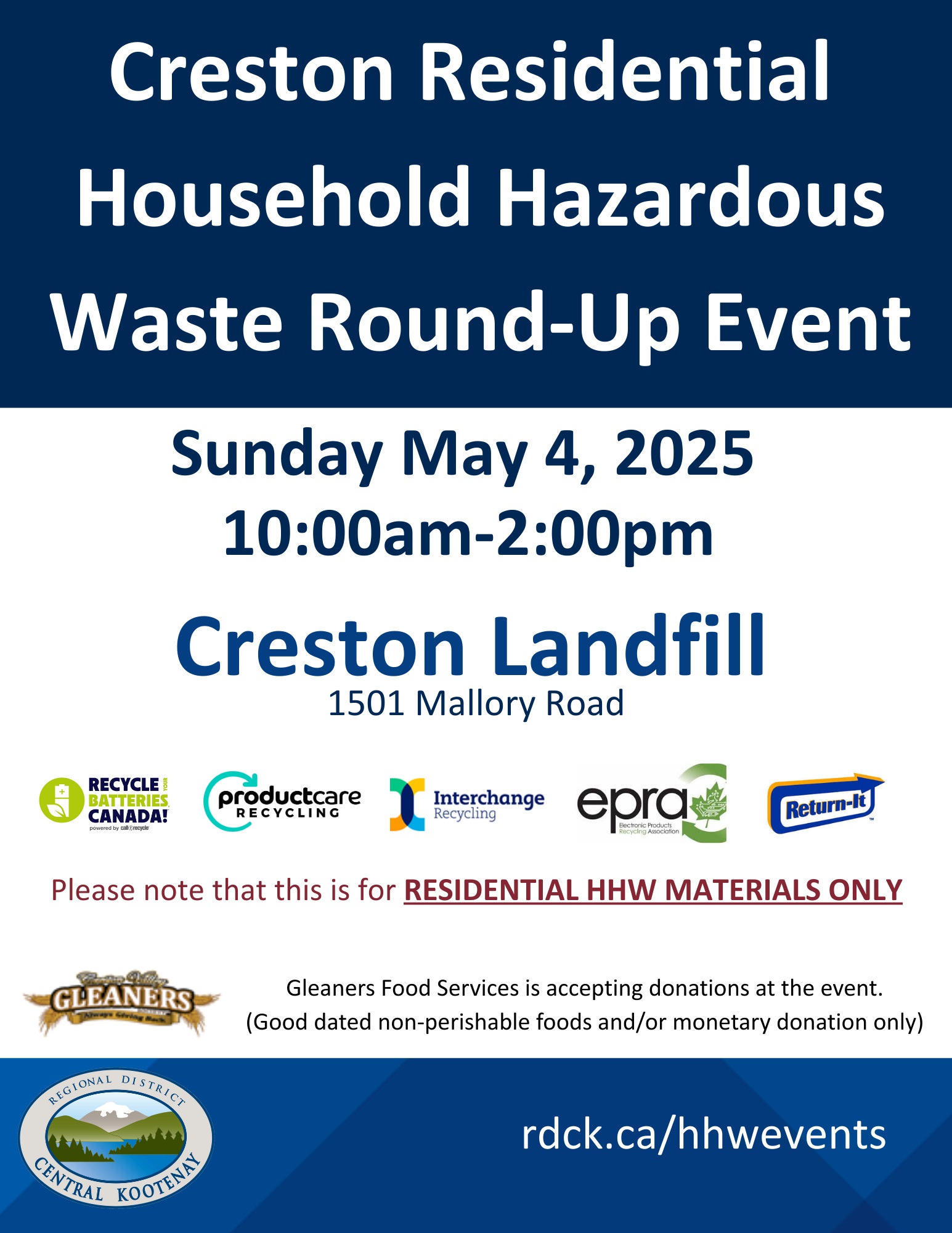
The RDCK is hosting a Spring Household Hazardous Waste Round-Up Event at the Creston Landfill, 1501 Mallory Road on Sunday May 4, 2025 from 10 am to 2 pm.
As this event will be well attended, your patience with both the traffic and the process will be much appreciated.
Please use the site map provided below to familiarise yourself with the traffic flow of the event this year. Traffic controllers will also be on site to assist.
Please note that if you miss this spring event, the RDCK is also hosting a fall event in Creston in September 2025. The event date will be announced around late June.