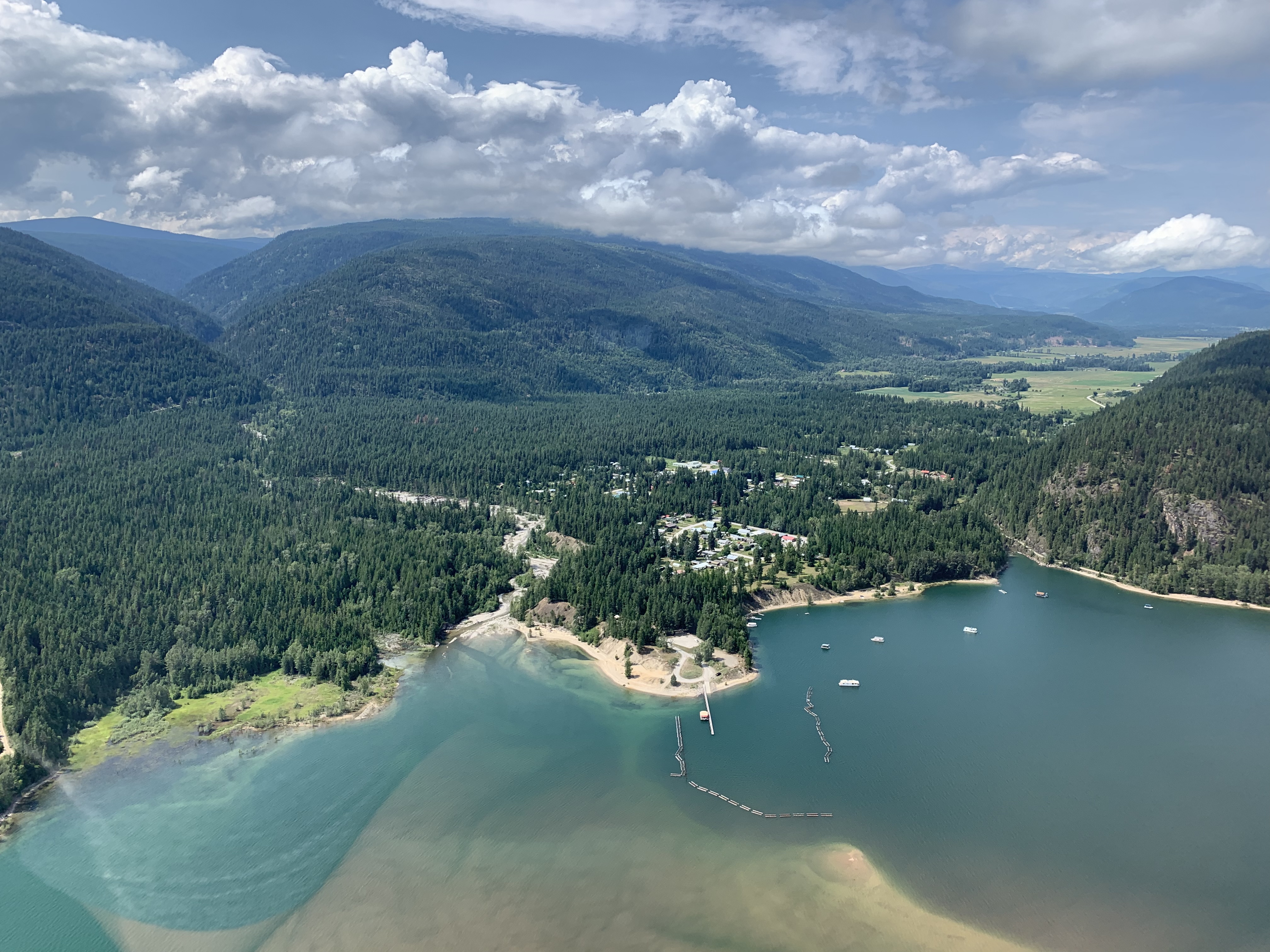
Nelson, BC: The Regional District of Central Kootenay (RDCK) has issued a Boil Water Notice and Emergency Water Restrictions for users on the Riondel Water System. The system is located in the community of Riondel, on the east shore of Kootenay Lake in Electoral Area A.
The Boil Water Notice and Emergency Water Restrictions have been issued due to a level sensor failure and high water demand resulting in very low reservoir levels that have depressurized portions of the distribution system. Operators are currently working to restore water production; however, reservoir levels will take several hours to recover.
The RDCK and Interior Health recommend that all customers drink boiled water or a safe alternative until further notice. Water intended for drinking, washing fruits and vegetables, making beverages or ice, or brushing teeth should be boiled for one minute. Boiled water should then be refrigerated in a clean, covered container. Customers could also choose to use bottled or distilled water.
Emergency water restrictions include the following essential uses only:
· Drinking water
· Food preparation
· Minimal laundry/sanitary
· No irrigation permitted
Owners of all public facilities must post a Boil Water Notice at all sinks or drinking water fountains accessible to the public (alternatively, public fountains and taps may be turned off). As opportunities arise, they must also advise their clientele verbally of the Boil Water Notice.
The RDCK will be taking measures to reduce risk; water quality will be monitored, and the public will be notified when the RDCK is able to lift the Boil Water Notice and when reservoir levels have returned to normal.
We apologize for any inconvenience this might cause and appreciate your cooperation and patience during this time. For more information contact the RDCK (250) 352-8161 or visit our website at www.rdck.ca/water.
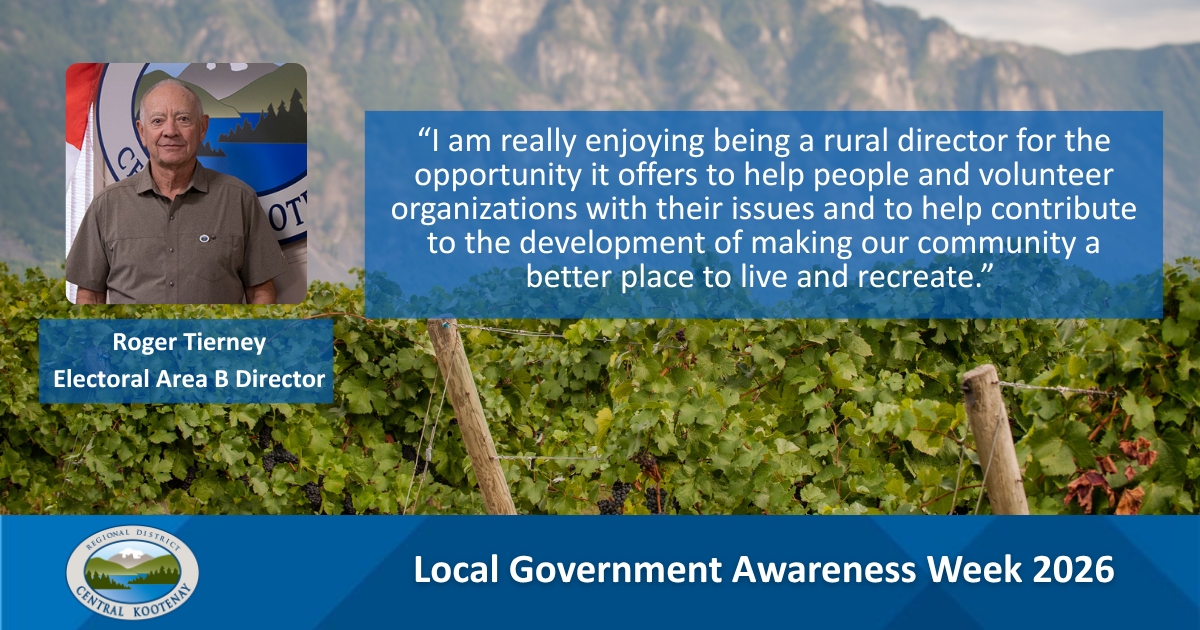
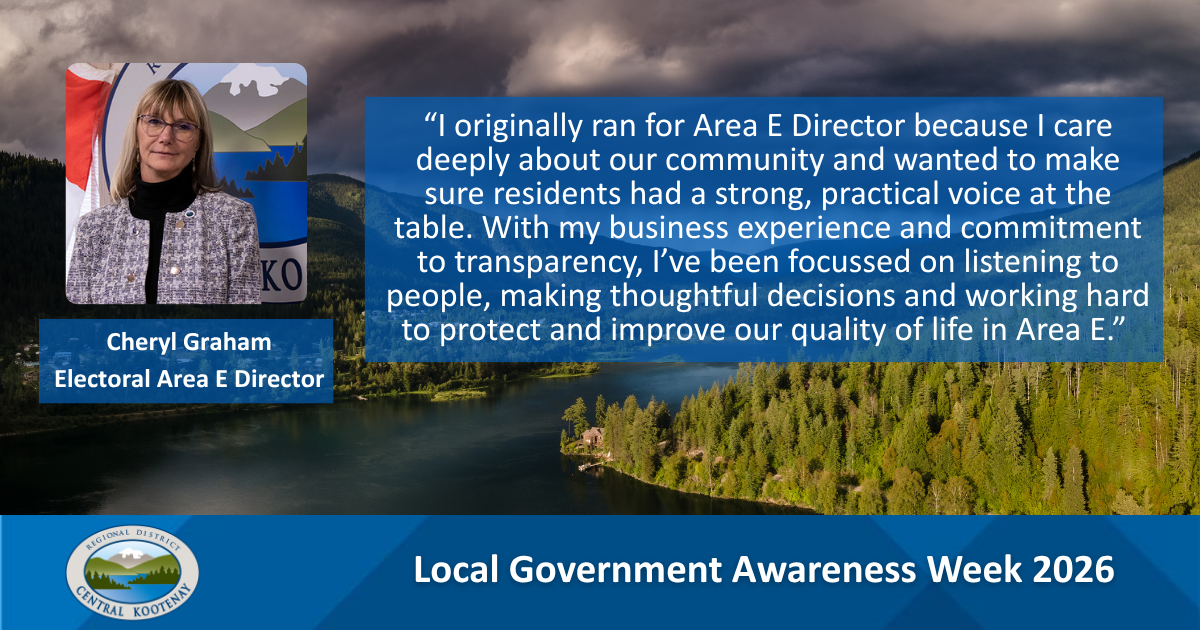
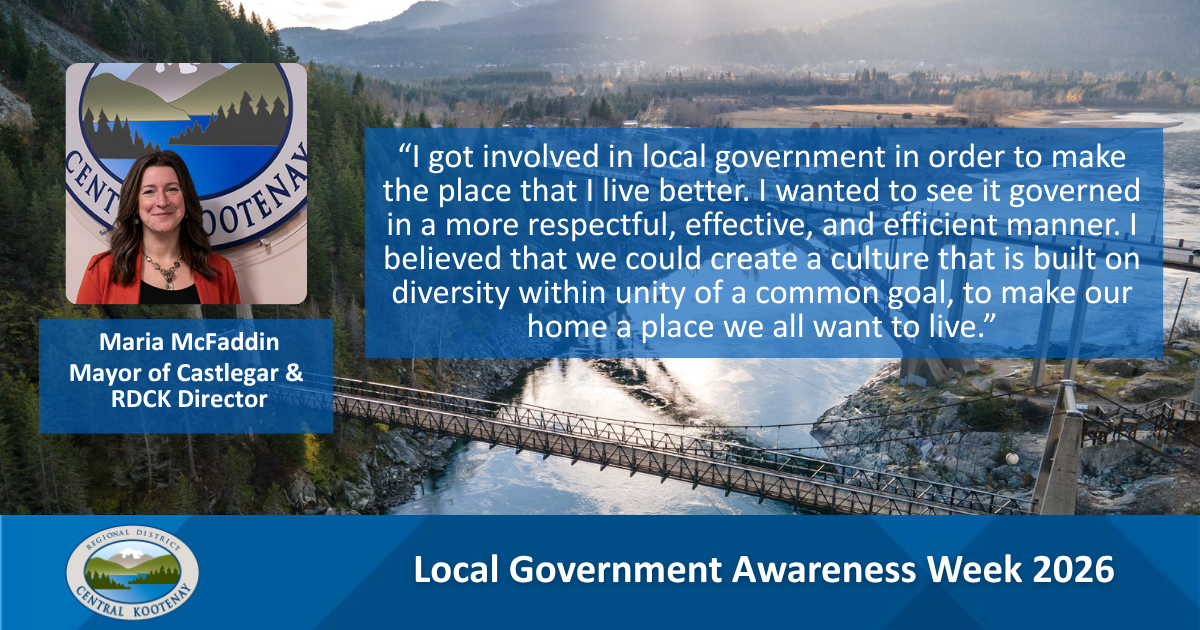
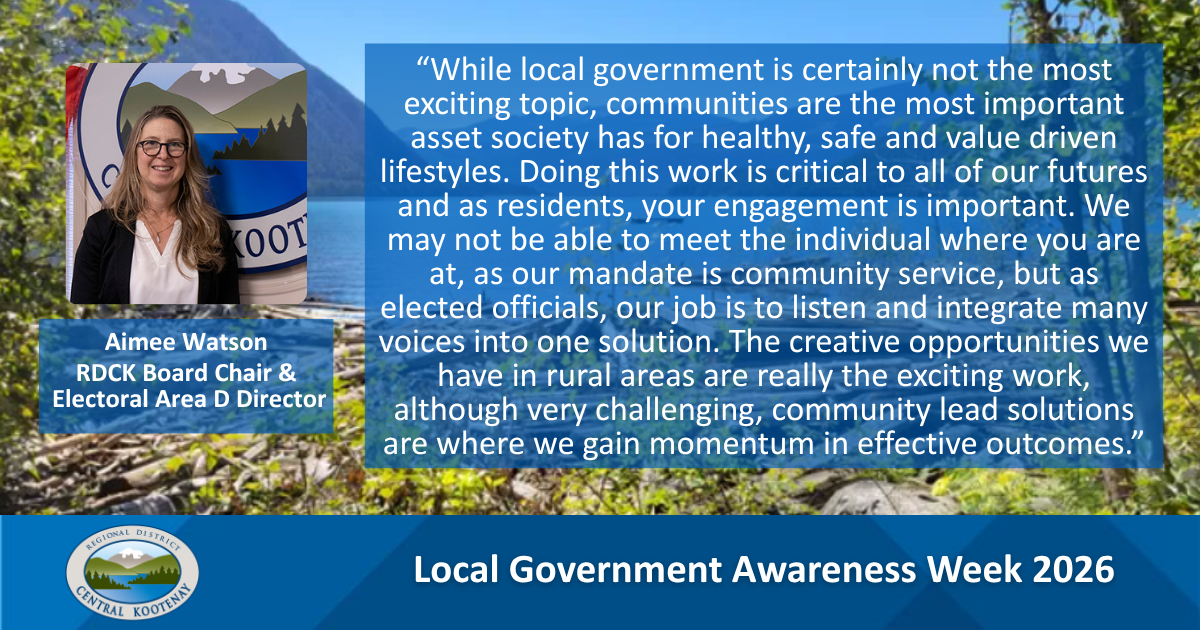
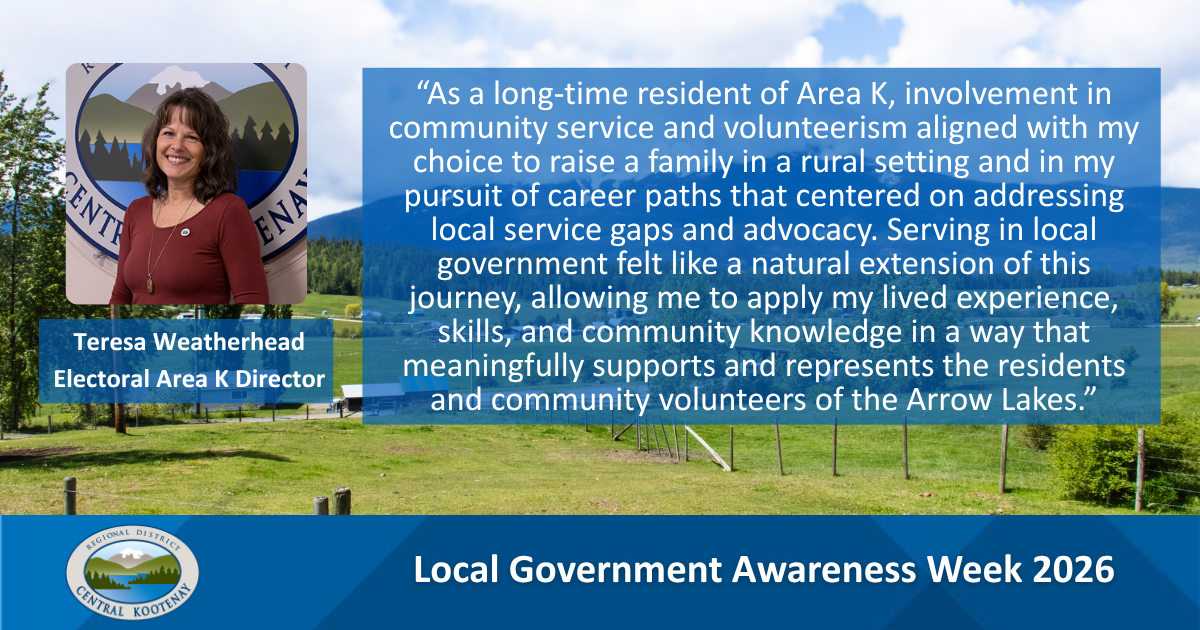
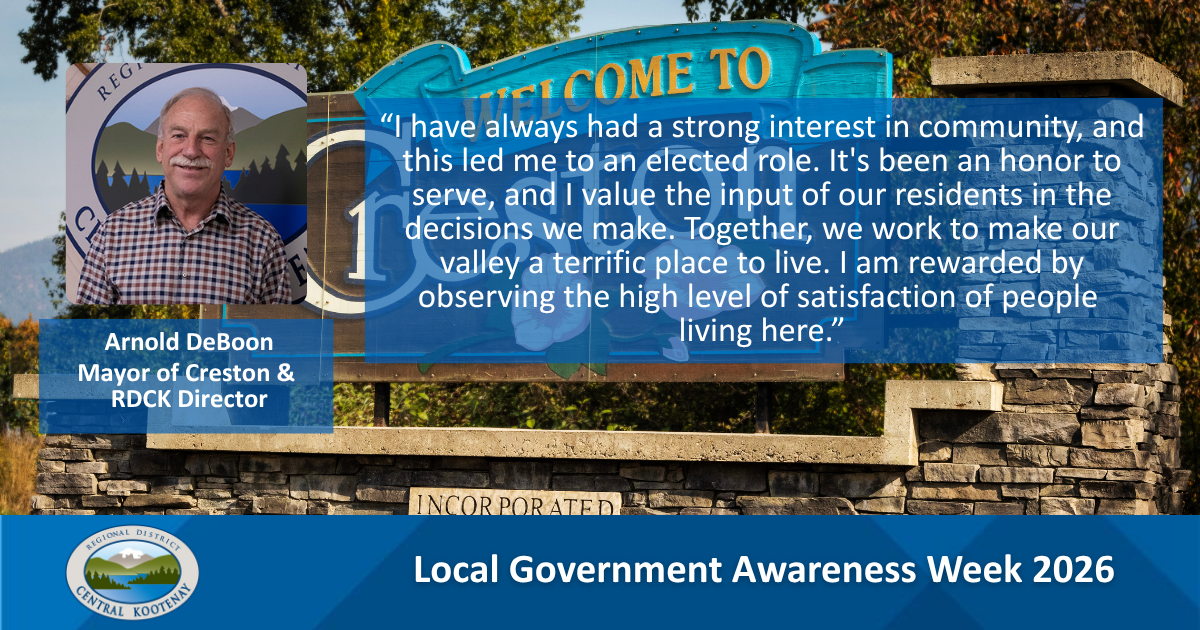
Local Government Awareness Week (May 10-16) is an opportunity to learn more about the important role local governments play in our everyday lives and communities.
Incorporated in 1965, the Regional District of Central Kootenay (RDCK) is a local government that serves an estimated population of 60,000 residents. The region consists of 11 electoral areas (A, B, C, D, E, F, G, H, I, J, K) and nine member municipalities: Castlegar, Creston, Kaslo, Nakusp, Nelson, New Denver, Salmo, Silverton and Slocan. The RDCK is led by 20 Board Members who are dedicated to serving their communities and helping guide regional decision-making.
From water and wastewater services, recreation facilities, emergency management, planning, roads, and environmental stewardship, local governments help deliver the essential services that residents rely on every day.
At the RDCK, Local Government Awareness Week supports our ongoing goal of increasing public awareness and understanding of local government roles and responsibilities, while encouraging residents to participate in local government processes and decision-making.
Public engagement and community participation are essential to building strong, informed, and connected communities. Whether attending Board meetings, participating in public engagement opportunities, or staying informed on regional initiatives, every resident plays an important role in shaping the future of our region.
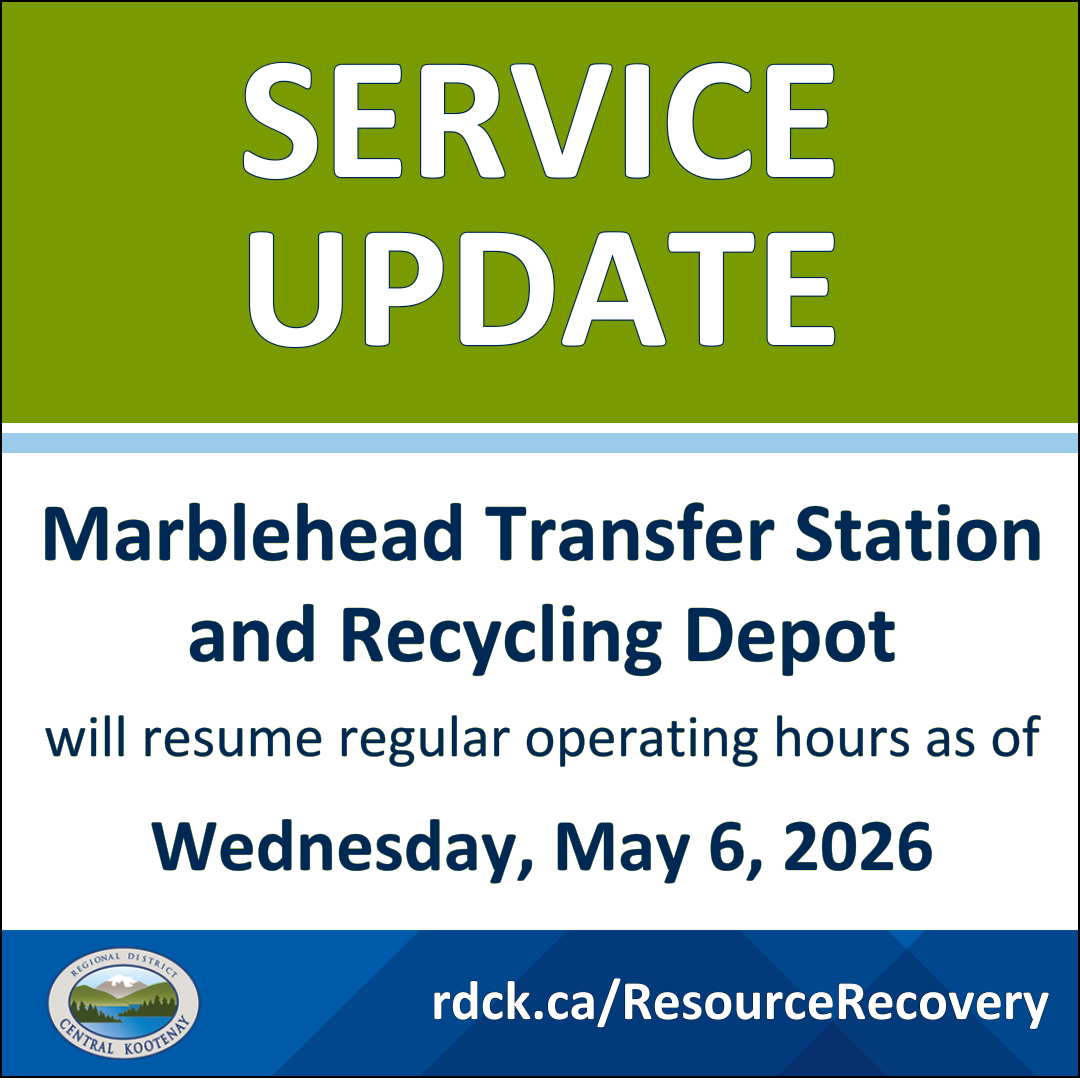
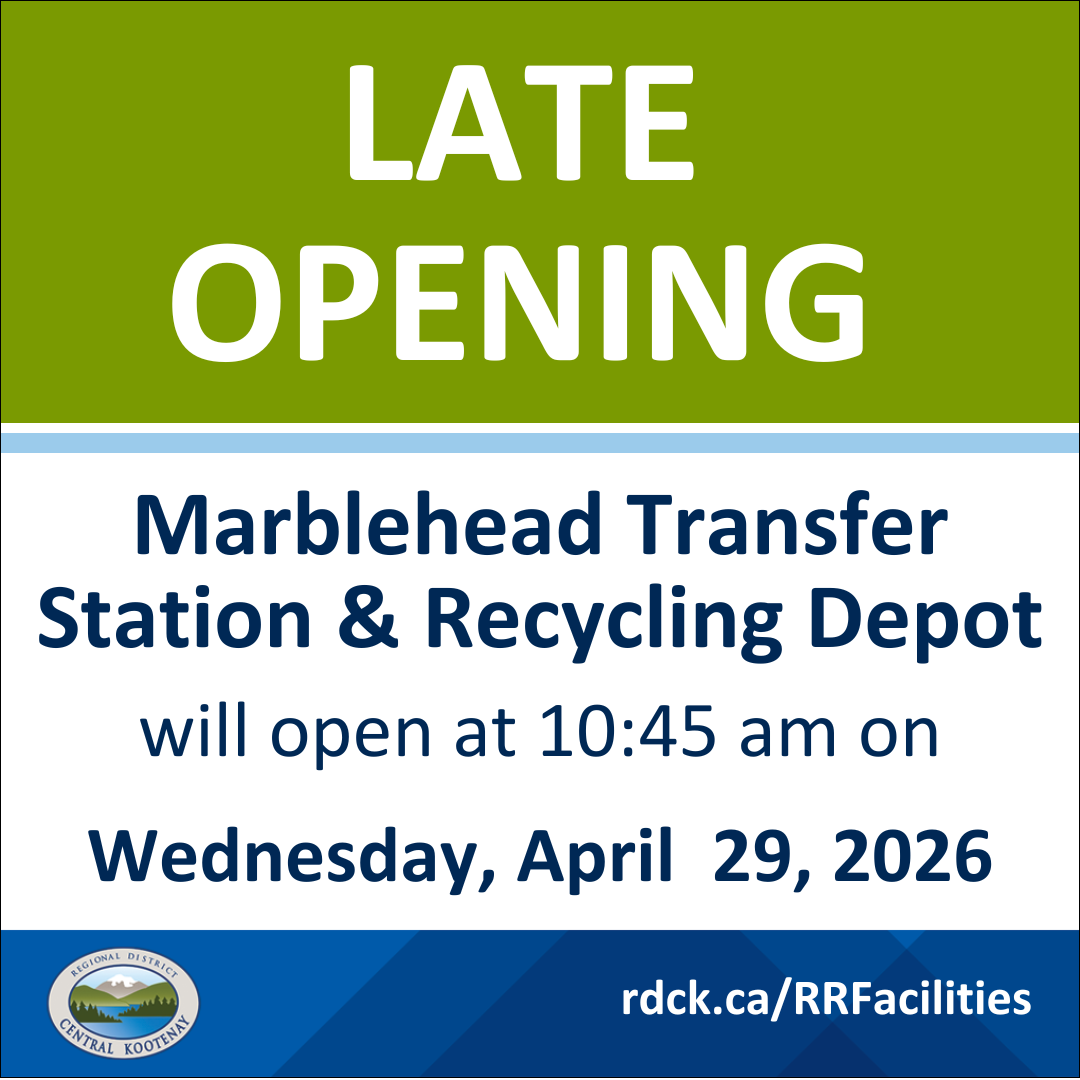
The Marblehead Transfer Station and Recycling Depot will resume regular operating hours effective Wednesday, May 6, 2026.
The Regional District of Central Kootenay apologizes for the inconvenience caused by the unplanned closure of the site on Saturday, May 2, 2026. Unfortunately, circumstances did not allow for advance public notification.
Measures will be implemented to reduce the chance for recurrence of this situation.
We appreciate the public’s understanding and patience.
Nelson, BC: In It Together is the theme for this year’s Emergency Preparedness Week (May 3–9), a national campaign that highlights how social connection can strengthen readiness. Whether it’s a wildfire, flood, or power outage, our ability to respond and recover is stronger when we work together as neighbours, families, and communities.
At the Regional District of Central Kootenay (RDCK), we’re encouraging residents to use this week as an opportunity to take action, talk to your family about your emergency plan, build or update your grab-and-go kit, and check in with neighbours, because we’re all in it together.
As part of Emergency Preparedness Week, the RDCK will conduct its annual TEST of the Emergency Notification System on Thursday, May 7 at approximately 2:00 PM. Anyone registered with the RDCK’s Emergency Notification System will receive a TEST NOTIFICATION by text, email, landline, or through the Voyent Alert! app, depending on their chosen settings.
The Province of BC will conduct a separate TEST of their notification system on May 6, 2026, at 1:55 pm PT.
If you are new to the area or have not yet signed up for emergency notifications, please go to www.rdck.ca/EmergencyNotification. To ensure you receive important emergency information relevant to your location, it is imperative that residents update their account with accurate location information. Please take this opportunity to log in to the system and double check your details: www.rdck.ca/EmergencyNotification.
“Emergency preparedness is everyone’s responsibility,” said Nora Hannon, RDCK Acting Emergency Program Manager. “By working together, we can build resilience towards the emergencies that impact our communities .”
Emergency Preparedness Week is a great time to take a few simple steps to improve your readiness:
The Board approved the 2025 audited financial statements by BDO Canada. Audited financial statements provide a consolidated and independently verified overview of a local government’s financial activities over the course of the previous fiscal year and its financial position at the end of that year. Click here to view the 2025 audited financial statements.
New user fees and rental fees for RDCK Community Services
The Board approved updated user and rental fees for RDCK Community Services, effective September 8, 2026, at the Castlegar & District Community Complex, Creston & District Community Complex, Nelson & District Community Complex, Salmo & Area G Recreation, and RDCK outdoor spaces.
Fees are reviewed annually to ensure alignment with the RDCK Fees & Charges policy, including cost recovery targets and the balance between user and community benefit. For the majority of fees, the 2026 updates reflect the February 2026 British Columbia Consumer Price Index (BC CPI) increase of 1.8%, which applies to admissions, memberships, aquatics rentals, room rentals, and field rentals.
To continue working toward target rates in the Fees & Charges policy, ice arena rentals will increase by 10%, and aquatic rental rates in Salmo and Creston will increase by an average of 6.8%.
Click here for the new fees and charges for admissions and rentals.
Upgrades to Balfour and Kaslo Transfer Stations
The Board approved the RDCK enter into a services agreement with McNally Excavating Inc. for the Balfour and Kaslo Transfer Stations to a maximum value of $75,210.50 plus GST. The work is necessary to complete required closure of portions of these sites which previously had been actively landfilled. The capping and final closure of the landfill portions of these sites will enable closure of existing permits, minimize the long-term environmental footprint, and incorporate better stormwater management to protect local water resources. The scope of work at Balfour includes regrading of the wood chip slopes, while the Kaslo work will include regrading the site, installing sufficient soil material, and establishing vegetation.
Ootischenia Transfer Station Upgrades
The Board directed staff to award the contract for the Ootischenia Transfer Station Option 3 Design to Sperling Hansen Associates Inc. to a maximum value of $162,741 plus GST. The new design, which will be completed by July, will include upgrades to the transfer area, the addition of a second scale, a separate entrance for recycling traffic, plus a larger tipping area with full size roll off bins. Following the planned construction of the upgrades, the site will have better traffic flow, increased safety, decreased wait times, and capacity to accommodate future expansion.
Regional and Local Community Needs Project
The Board received the final report completing the Regional and Local Community Needs Project, which was funded under the province’s Complete Communities Program administered by the Union of BC Municipalities. The City of Castlegar, City of Nelson, Town of Creston, Village of Kaslo, Village of Nakusp, Village of Salmo, and Village of Slocan were partners with the RDCK on this project, which focused on growth management planning to ensure efficient expansion of servicing and infrastructure in line with long-term community development goals. The project’s final report represents a holistic regional growth management assessment.
The results of this assessment can be used to identify additional housing needs; improve connections between residents and services or amenities they frequently access; understand how servicing infrastructure can be used more efficiently; and guide where growth should be directed. The final report identifies key areas for potential growth and provides direction to support proposed growth, such as housing, asset management, servicing, and public transportation. The implementation plan is based on the consolidation of a significant amount of data analysis and mapping that integrates the data for all seven participating municipalities and the RDCK with a focus on actions that can be taken to guide growth in a holistic and collaborative manner.
Kaslo and North Shore Fire Departments to provide Interior Service Level
The Board adopted policy amendments to authorize Kaslo and North Shore Fire Departments to provide Interior Service Level. Operating at an Interior Service Level will allow the departments to action fires within structures when safe to do so, thereby mitigating loss of life and property. Exterior Service Level, which these departments were previously authorized for, only allows for fire suppression from the outside of a structure. The policy update aligns service levels with the capabilities that now exist within the local departments. Both the Kaslo and North Shore departments have increased membership, suitable equipment, and demonstrated operational reliability to provide the increased service.
RDCK Quarterly Report
The RDCK Quarterly Report provides a condensed summary of active projects and initiatives within the RDCK. The report includes a clear and concise understanding of each project and its connection to the Board’s strategic priorities. Click here to view the latest quarterly report, including the most recently completed projects.
Click here to view the quarterly report page on the RDCK website.
Director’sReports
RDCK Directors provide monthly reports outlining what they have been working on. Click here to read the April reports in the Board minutes.
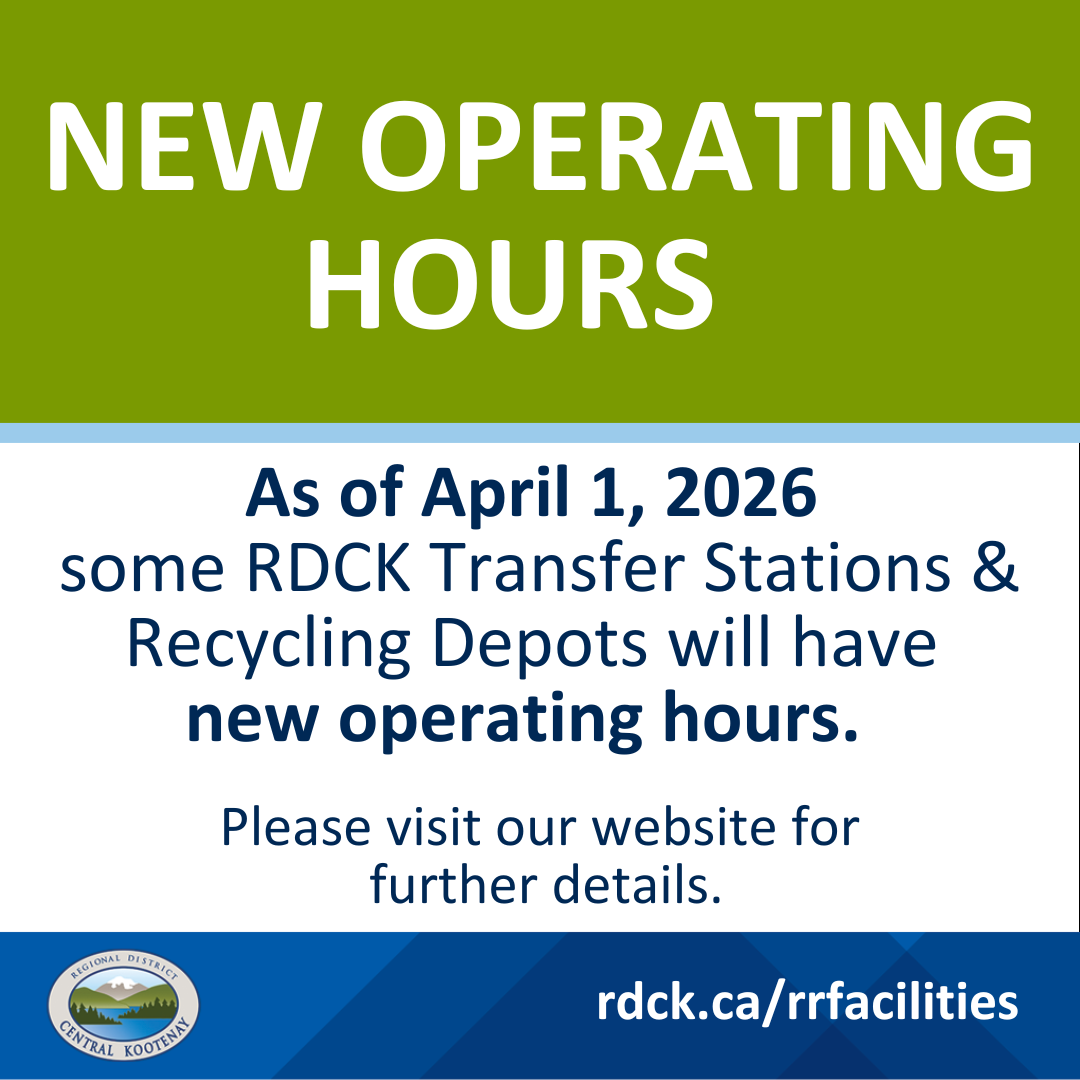
Based on recommendations from an Hours of Operation Review, the Board approved adjustments to operating hours at the Balfour, Boswell, Crawford Bay, Kaslo, Salmo, and Nelson (Lakeside) facilities effective April 1, 2026. The Hours of Operation review looked at site traffic and distance to nearby waste facilities with an aim of improving cost effectiveness and balanced service delivery across the region.
The Board of Directors adopted the 2026-2030 Financial Plan Bylaw, an annual requirement which must be completed by end of March each year. This year’s budget will see a 4.7% average increase in property taxes for RDCK residents, although a resident’s actual increase will vary depending on the Electoral Area or Municipality the resident lives in.
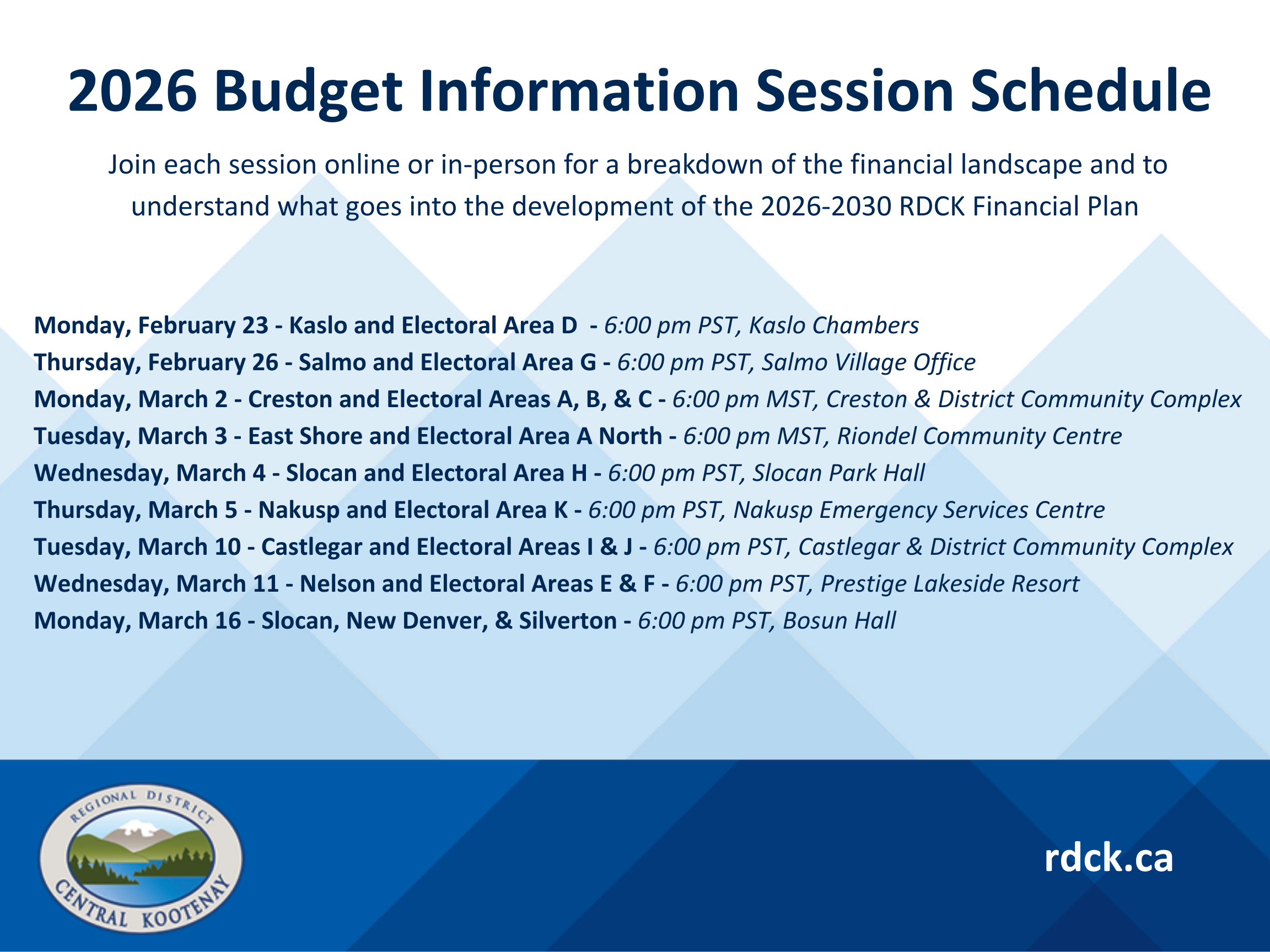
To allow the public in our various sub regions to comment and provide feedback on the five-year Financial Plan, the RDCK had a dedicated page (2026 Budget Planning) on its public engagement website, as well as hosted nine hybrid public information sessions (in-person and online), and one Special Budget Meeting over the last two months.
Residents are encouraged to review the financial plan and reach out to staff or Directors with questions.
Columbia Basin Trust to provide grant for RDCK parks system
The Board resolved to enter into a contribution agreement with Columbia Basin Trust for the Regional District of Central Kootenay Regional Park Enhancement Program. Columbia Basin Trust will provide a grant in the amount of $1,050,000 which can be used for enhancements in the 27 existing RDCK Regional Parks in Electoral Areas A, D, E, F, G, H, I, & J. The funding is intended to support inclusive and accessible enhancements, to reduce hazards and improve visitor awareness, and help parks adapt to climate change. The work must be completed in at least 60% of the 27 regional parks and be delivered within a two-year timeline.
Electoral Areas A, B, & C Dangerous and Aggressive Dog Control Service – Alternative Approval Process
The Board directed staff to proceed with obtaining approval of the electors in Electoral Areas A, B, and C for the adoption of the Dangerous and Aggressive Dog Control Service Establishment Bylaw. The new bylaw would establish a service to regulate dangerous and aggressive dogs. Approval is to be obtained through the Alternative Approval Process (AAP). The Board obtains approval if fewer than 10% of eligible electors in the area covered by the AAP submit elector response forms in opposition of the matter. Following the formal initiation of the AAP process on May 7, 2026, the deadline for receipt of elector responses will be 4:00 pm on Monday, June 15.
Ootischenia Fire Department to purchase replacement engine
The Board approved the purchase of a used frontline fire engine, including upgrades, for the Ootischenia Fire Department for a total cost not exceeding $600,000. The Ootischenia Fire Department has been using a temporary replacement engine since its frontline fire engine experienced a catastrophic mechanical failure in 2024. The proposed unit from Rocky Mountain Phoenix is available for immediate purchase and can be inspected, refurbished, and commissioned within approximately 9-14 weeks.
Castlegar and District Arena and Walking Track Project
The Board approved Naming Rights and Wood Integration Guidelines for the Castlegar and District Arena and Walking Track Project, along with direction to incorporate these into the project’s procurement process. These decisions represent one step in a larger process, helping the RDCK develop a thoughtful and well-defined procurement approach that reflects community priorities and sets the project up for success.
The development of a new arena and indoor walking track was identified as a public priority through the Reimagining Recreation Engagement Project and will need elector assent (referendum for the City of Castlegar and Electoral Area J) to move forward.
In simple terms, naming rights will be included as part of the project to help support the delivery of the project within the $15 million budget and reduce the financial impact on taxpayers. At the same time, the facility will remain a fully public asset, with all operating revenues staying with the RDCK. The approved guidelines set clear expectations for how naming rights will be managed.
The Board also approved guidelines that support a strong focus on design quality and sustainability, encouraging the use of wood in the facility’s construction and design. Proposals that demonstrate meaningful wood integration will be recognized in the evaluation process, while still ensuring overall value, functionality, and cost remain key priorities.
Erickson Water System – Residential Meter Contract
The Board directed staff to award the contract for the Erickson Water System (Electoral Area B) – Residential Meters Installation Contract Package 1 to Valhalla Hydrovac Ltd. for a maximum value of $328,637.41 plus GST. This is the first tender/contract package to install 506 meter pits in Erickson. The RDCK has broken these 506 pits into multiple tender/contract packages which makes geographical sense and enables RDCK staff to inspect and monitor construction. The installation of contract package 1 is estimated to start in the spring of 2026 with substantial completion by June 30, 2026.
Metering 506 pits is part of Phase 2 of the Erickson Water System Metering Project. This phase of the project is completely funded by the Provincial Meter Pilot Project. Erickson Water System regularly faces capacity challenges from increased water needs and reduced summertime flows in Arrow Creek. By installing meters and boosting demand-side management via leak location and repair, the RDCK is ensuring water is being used where it is intended.
Phase 1 of the metering project is well underway, which will result in 136 meters installed on industrial, agricultural, and institutional services along with agricultural land with five acres or more of irrigation privilege.
RDCK Quarterly Report
The RDCK Quarterly Report provides a condensed summary of active projects and initiatives within the RDCK. The report includes a clear and concise understanding of each project and its connection to the Board’s strategic priorities. Click here to view the latest quarterly report, including the most recently completed projects.
Click here to view the quarterly report page on the RDCK website.
Director’sReports RDCK Directors provide monthly reports outlining what they have been working on. Click here to read the March reports in the Board minutes.
Spring is right around the corner and typically it is a busy time for builders and home owners to break ground on new projects. Interested in adding a secondary suite to your house? How about renovating your commercial space? What about constructing your dream home? Securing a building permit in the Regional District of Central Kootenay (RDCK) is often the first tangible step in turning ideas and dreams into progress. For residents, builders, and business owners alike, the process is more than paperwork — it is a collaborative effort between the community and local government to ensure projects are safe, compliant, and thoughtfully integrated into the area’s landscape. From initial application to final approval, obtaining a permit reflects both the responsibility of development and the shared commitment to protecting the infrastructure and long-term wellbeing of the region.
The RDCK is responsible for issuing building permits in 11 Electoral Areas and six Municipalities. In 2025, the RDCK issued 363 permits in Electoral Areas and 84 permits in Municipalities (Kaslo, Nakusp, New Denver, Salmo, Silverton, and Slocan).
Obtaining a building permit through the RDCK is a straightforward process when applicants are prepared. The timeline can vary based on the quality of an application to ensure an efficient review time. To avoid delays, applicants are encouraged to plan at least three months ahead of their intended construction start date and ensure they submit a complete and compliant submission.
The most common setbacks stem from engineering requirements from complex designs, misunderstandings around bylaws, development variances or zoning requirements, and failing to confirm whether a permit is required. The first step is reviewing the RDCK building brochure and, if uncertain, contacting staff. Collaboration is part of the service — while staff do not design projects, they can clarify requirements, discuss options, and even look over plans before a formal submission to ensure you are on the right track.
“Our goal is to make the building permit process as smooth and transparent as possible for the community,” said Erik Stout, RDCK Building and Bylaw Manager. “We work closely with applicants to answer questions early, review submissions thoroughly, and help them understand the requirements before construction begins. At the same time, we have a responsibility to ensure projects are completed safely and in compliance with regulations. By working together from the start, we can help applicants move forward with confidence, knowing their build is being done correctly and to a standard that protects both their investment and the occupants of the building.”
Working with a reputable designer is strongly recommended, as incomplete or outdated plans can significantly delay approval. In some cases, engineered plans are required for specific structural components, while designers prepare the overall building plans. Early in the process, applicants should also retain an energy advisor to complete pre-construction energy modelling required under the BC Energy Step Code, if constructing a new home.
It is important to note that incomplete applications do not enter the review queue. Beginning construction without an issued permit can result in a stop work notice, fines, and even a notice registered on the property title.
With preparation, professional support, and early communication with staff, the building permit process can move efficiently and help ensure a safe and compliant project.
Preparations for the reconstruction of the Marblehead Transfer Station are underway, and repairs are planned to commence in early summer when site conditions and weather permit.
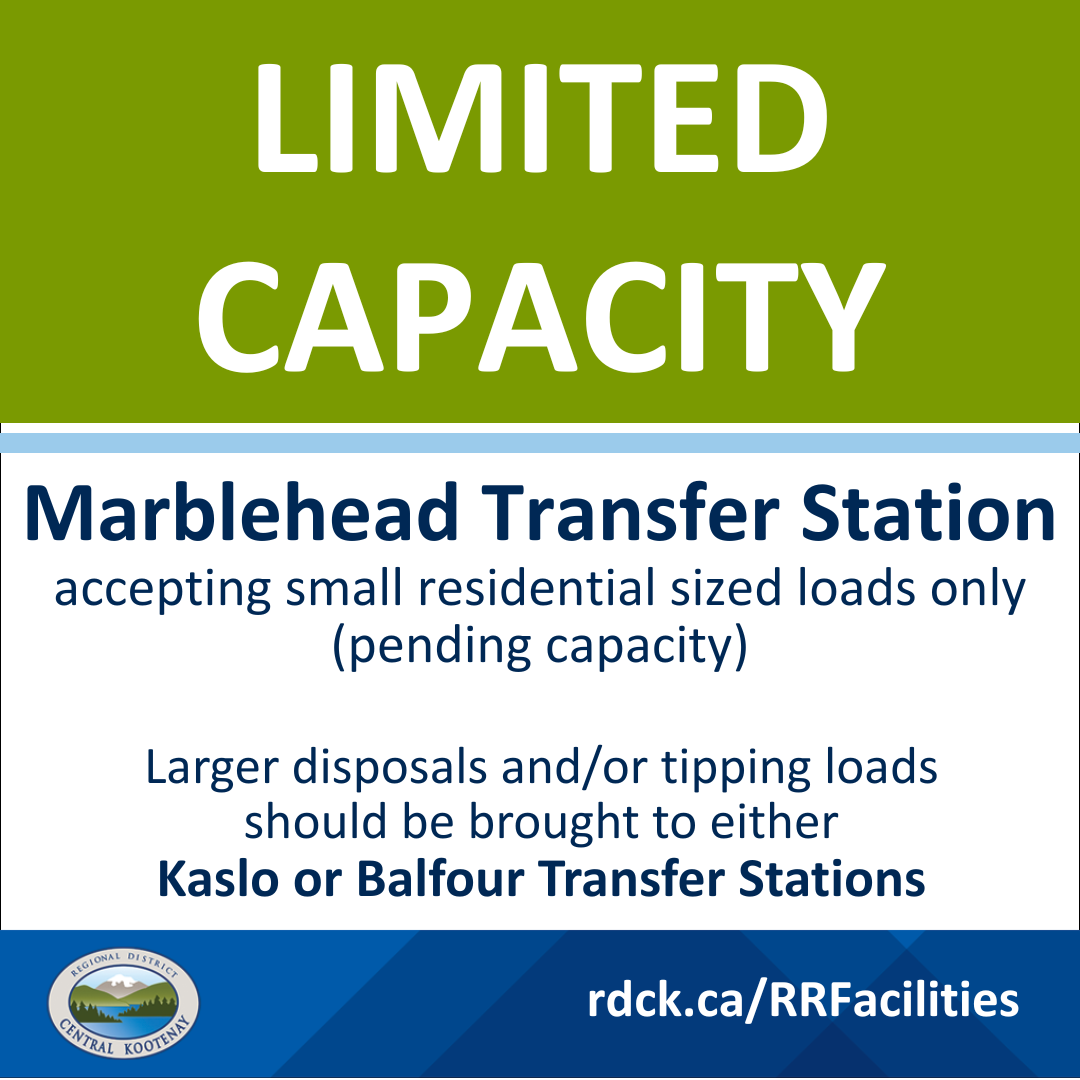
The Marblehead Transfer Station will continue to operate at limited capacity for Mixed Waste, only accepting small residential sized loads until the bin wall reconstruction is completed. All diversion materials (recycling, wood, metal, etc.) are functioning at regular capacity. The RDCK will inform the community in advance if full service interruptions will be experienced during construction.
Residents can bring larger disposals or those that require tipping to either the Kaslo or Balfour Transfer Stations.
Effective immediately, the RDCK volunteer fire departments in Beasley (Electoral Area F), Ootischenia (Electoral Area J), and Robson (Electoral Area J) will now provide auto extrication service. Each department has the necessary tools, certified personnel, and demonstrated capability to safely conduct auto extrication within its own protection area. Overall, this will strengthen regional resilience by ensuring each department can deliver essential services within its own area, as well as improve response time and reduce out of area deployments from neighbouring departments.
Local Conservation Fund
The Board approved $139,972 in grant funds for the Local Conservation Fund to be spread among nine different projects. The Local Conservation Fund is funded through a $15 parcel tax and provides grants to support local conservation efforts in Electoral Areas A, D, E, F, and H focused on the conservation of water and aquatic systems, as well as wildlife and habitat. Here are the nine projects:
PROJECT
PROPONENT
AMOUNT
Grizzly Bear Coexistence Solutions
Lardeau Valley Opportunity LINKS
$15,000
Bat Roost Enhancement and Activity Monitoring in the West Kootenays
Wildlife Conservation Society Canada
$24,955
Kootenay Nature for Neighbourhoods Program
Central Kootenay Invasive Species Society
$14,624
Harrop Wetlands Project
Friends of Kootenay Lake Stewardship Society
$13,000
Slocan Valley Pollinator Highway Project: Phase 1 Year 3
Elk Root Conservation Farm Society
$18,393
Construction and Conservation of Artificial Bat Roosts in the West Kootenays
Okanagan Nation Alliance
$15,000
Water Monitoring for Climate Resilience in the RDCK
Living Lakes Canada
$15,000
Advancing Wetland Stewardship & Restoration in the Kootenays
BC Wildlife Federation
$14,000
Planning for the Future: Watershed Security in a Changing Climate
West Kootenay Watershed Collaborative Society
$10,000
Ootischenia Landfill Upgrades
The Board approved the preferred conceptual layout for upgrading the Ootischenia Landfill. Considered one of the RDCK’s primary regional waste management and disposal facilities, the potential to expand the facility would help to alleviate traffic congestion, long customer wait times, improper disposal of waste, and a reduced desire to properly divert recyclable materials. The approved conceptual layout includes upgrades to the transfer area, the addition of a second scale, a separate entrance for recycling traffic, plus a larger tipping area with full size roll off bins which will provide better traffic flow, increased safety, scalability, and capacity to accommodate future expansion.
Ymir Transfer Station and Satellite Recycling Depot Closure
The Board approved the permanent closure of the Ymir Transfer Station and Satellite Recycling Depot effective December 31, 2026. Based on recommendations from the 2024 System Efficiency Study and staff studying traffic data and providing operational feedback, the facility provides only limited waste management options, is open just one day a week, and the cost to operate the facility is double what the average annual tipping fee revenue is, which means the difference is made up through taxation. Further, the site’s bin wall needs repairs or replacement, which could cost up to $200,000.
Residents in Electoral Area G have a comparable distance to waste management facilities as other rural residents across the RDCK, and better access than many rural areas in the RDCK based on the higher than average operating hours at the nearest facilities. Further discussion about the closure will occur at the upcoming Joint Resource Recovery Committee meeting in March, after the Board directed an extension to the closure to the end of the year.
HomeSave Program
The RDCK signed a memorandum of understanding with the City of Nelson for the purpose of establishing roles, responsibilities, and governance for the delivery of the HomeSave Program. Formerly known as the Regional Energy Efficiency Program (REEP), the HomeSave Program is a regionally focused residential energy efficiency initiative in the RDCK that supports homeowners across the region in reducing energy consumption, greenhouse gas emissions, and household energy costs through retrofits, incentives, and technical guidance. The new program is expected to roll out the first week of March.
New Arena & Indoor Walking Track Development Procurement – Castlegar
The Board approved entering into a professional services agreement with HCMA Architecture and Design for $180,000 to develop an owner’s statement of requirements for the design/build of a new arena with an indoor walking track in Castlegar. The development of a new arena and indoor walking track was identified as a public priority through the Reimagining Recreation Engagement Project and will need elector assent (referendum for the City of Castlegar and Electoral Area J) to continue beyond the design phase. The goal is to select a preferred proponent to build the new facility for $15,000,000 of maximum funding from the RDCK before the voter assent is to be held during the October 2026 municipal and RDCK elections.
RDCK Quarterly Report
The RDCK Quarterly Report provides a condensed summary of active projects and initiatives within the RDCK. The report includes a clear and concise understanding of each project and its connection to the Board’s strategic priorities. Click here to view the latest quarterly report, including the most recently completed projects.
Click here to view the quarterly report page on the RDCK website.
Director’sReports
RDCK Directors provide monthly reports outlining what they have been working on. Click here to read the February reports in the Board minutes.
For information on how to join each session online, go to the specific event in our meetings calendar. Click here for the RDCK meetings page. Zoom information will be provided closer to each public information session.
The RDCK and Village of Salmo are reviewing how we manage development near flood and steep creek hazard areas and updating our outdated policies and regulations.
Separately, the RDCK is developing a risk tolerance policy to strengthen risk-informed land use decisions and enhance community resilience in areas exposed to geohazards, such as floods, landslides, and steep creek hazards (debris flows and debris floods).
If you live in or near a flood, steep creek or landslide hazard area, these updates could influence how property can be developed or improved in the future. Join our project team for a live webinar to get the facts and ask your questions.
The Board held a special budget meeting on Friday, January 23, to review the current draft of this year’s financial plan. The draft is showing an average taxation increase of 8.7%, although actual changes vary widely based on property location. For example, the RDCK portion of Village of Slocan taxes are projected to be a 1.8% increase, while Electoral Area H is showing a 12% increase. The primary driver of the overall average increase is a $4 million increase in contribution to reserves to fund near term capital asset projects. Further changes to the Financial Plan are expected as there are ongoing budget reviews and discussions with Directors, staff, and at the committee level, as well as public engagement budget meetings throughout the region.
The budget process will conclude at the March 19 Open Board Meeting where Directors will have a final opportunity to discuss, modify, and consider adoption of the budget.
Click here to view the Draft 2026-2030 Financial Plan.
Re-designed quarterly report
The RDCK released its re-designed quarterly report. This report, organized by department, provides a condensed summary of active projects and initiatives within the RDCK. The new format provides a clear and concise understanding of each project and its connection to the Board’s strategic priorities.
Click here to view the recently completed projects on the latest quarterly report.
Click here to view the quarterly report page on the RDCK website.
Operational hours change at six resource recovery facilities
Based on recommendations from the 2024 System Efficiency Study and staff studying traffic data and providing operational feedback, the Board approved the following adjustments to operating hours for the following transfer stations and recycling depots effective April 1, 2026:
Facility
NEW HOURS – Effective April 1, 2026
PREVIOUS HOURS
Balfour Transfer Stations and Recycling Depot
Year round Monday, Wednesday, Friday, and Saturday 9:00 am – 3:00 pm
Summer (May 1 to September 30) Monday, Wednesday, Friday, and Saturday 9:00 am – 4:00 pm Winter (October 1 – April 30) Monday, Wednesday, Friday, and Saturday 9:00 am – 3:00 pm
Boswell Transfer Station and Recycling Depot
Year Round Saturday 10:00 am to 2:00 pm
Year Round Wednesday and Saturday 11:00 am to 3:00 pm
Central Transfer Station (Salmo)
Year round Wednesday and Saturday 10:00 am – 2:00 pm
Summer (May 1 – September 30) Wednesday and Saturday 9:00 am – 3:00 pm Winter (October 1 – April 30) Wednesday and Saturday 10:00 am – 2:00 pm
Crawford Bay Transfer Station and Recycling Depot
Summer (April 1 – September 30) Sunday, Tuesday, and Thursday 9:00 am – 3:00 pm Winter (October 1 – March 31) Sunday, Tuesday, and Thursday 10:00 am – 3:00 pm
Early March to April 30 Sunday and Tuesday 9:00 am – 3:00 pm May to Early November Sunday, Tuesday, and Thursday 9:00 am – 3:00 pm Early November to Early March Sunday and Tuesday 10:00 am – 4:00 pm
Lakeside Recycling Depot
Summer (April 1 – September 30) Monday to Saturday 8:30 am – 5:00 pm Winter (October 1 – March 31) Monday to Saturday 8:30 am – 4:30 pm
Year Round Monday to Saturday 8:30 am – 5:30 pm
Kaslo Transfer Station and Recycling Depot
Summer (April 1 – September 30) Tuesday and Friday 9:00 am – 3:00 pm Sunday 9:00 am – 4:00 pm Winter (October 1 – March 31) Sunday, Tuesday, and Friday 10:00 am – 3:00 pm
Summer (May 1 – September 30) Sunday, Tuesday, and Friday 9:00 am – 3:00 pm Winter (October 1 – April 30) Sunday, Tuesday, and Friday 10:00 am – 3:00 pm
The Board approved the adoption of the RDCK Accessibility Plan. The RDCK is committed to creating a community where diversity, equity, inclusion, and accessibility are deeply embedded in everything it does. This plan lays the groundwork for intentional, sustained efforts to ensure every resident can fully and equally take part in community life. Click here to read the plan.
Dangerous and Aggressive Dogs Service
The Board read Bylaw No. 3009, the Regional District of Central Kootenay Dangerous and Aggressive Dog Regulatory Bylaw, a third time by content. The bylaw provides a regulatory framework for contracted Regional District Dog Control Officers and the RCMP to address aggressive dog incidents in Electoral Areas A, B, C, and H. While Electoral Areas A, B, and C would like further analysis prior to moving forward with service establishment, Electoral Area H is proceeding with Bylaw 3066, the Electoral Area H Dangerous and Aggressive Dog Control Establishment Bylaw. The Board read the bylaw for a third time by content, which allows Electoral Area H to go ahead in seeking voter assent. The bylaw and supporting information will now be sent to the Local Government Inspector for statutory approval, which typically takes 6-8 weeks. This could potentially allow for a general polling day as early as May 2026.
The proposed ballot question is:
Electoral Area H Dangerous and Aggressive Dog Control Service Establishment Bylaw No. 3066, 2025 will allow the Regional District to establish a service for the regulation of Dangerous and Aggressive Dogs in Electoral Area H and to establish a maximum annual allowable requisition not to exceed the greater of $ 109,741 or the amount resulting from a rate of $0.077/$1,000 applied to the actual net taxable value of land and improvements in the service area.
Are you in favour of the Regional District adopting Electoral Area H Dangerous and Aggressive Dog Control Service Establishment Bylaw No. 3066, 2025? Yes or No
Director’sReports
RDCK Directors provide monthly reports outlining what they have been working on. Click here to read the January reports in the Board minutes.
Nelson, BC: The Regional District of Central Kootenay (RDCK) is moving forward with regulating the disposal of organic waste for the Industrial, Commercial, and Institutional (IC&I) Sector, with a nine-month implementation window in 2026 to allow ample time for the change.
The regulation will initially target larger food-primary operations such as grocery stores, busy restaurants, and commercial food manufacturers in the communities of Creston, Castlegar, Salmo, and Nelson, where services exist. Commercial, non-residential waste from these communities that arrives at the Creston Landfill, Ootischenia Landfill, Central Transfer Station, and Grohman Narrows Transfer Station will eventually be required to separate compostable organic waste from landfilled waste.
“Our Board wants to encourage organic waste diversion by supporting the private sector with rebates and reduced tipping fees, so in combination with that, we recognize that regulation is the most effective tool the Regional District has at getting the levels of participation needed to meet our waste diversion goals,” said Aimee Watson, RDCK Board Chair.
It is estimated that up to 3,900 tonnes of compostable organic waste can be kept out of our regional landfills annually if the IC&I sector fully participates in organics diversion. The IC&I sector is responsible for an estimated 45% of landfilled waste in our region. Of this material, 35% is estimated to be compostable organics, making it the RDCK’s largest single-stream waste diversion potential.
Whenever possible, food and beverage related operations in the affected communities will be contacted by email and direct mail, with additional advertisements in the local newspapers and on social media throughout 2026 to build awareness of these changes. Information events held in conjunction with stakeholder groups will be held in the early spring and summer.
Organic Waste Disposal Facility in Creston
The new regulation was included in the Resource Recovery Facilities Regulatory Bylaw update for 2026, as approved by the RDCK Board of Directors. Definitions were added to the Bylaw to include compostable organic waste originating from Industrial, Commercial, and Institutional sources as a type of “Recyclable Material”.
Recyclable Materials are items that can be easily separated from mixed waste (garbage) and diverted to cost-effective recycling solutions. As per the Bylaw, when more than 10% of a load contains recyclable materials and is landfilled, the entire load is subject to a variable tipping fee set at double the price of mixed waste ($354.50/tonne). This currently occurs with items like corrugated cardboard and has been an effective tool for keeping this material out of our landfills.
A subsidized tipping fee of $55/tonne for separated organic waste originating from the IC&I sector is being maintained in 2026. This makes commercial organic waste disposal significantly less expensive than mixed waste, which is currently charged at $177.25/tonne.
Affected businesses and institutions will have the majority of 2026 to make the necessary changes to their operations. By September 2026, the RDCK will begin issuing warnings before applying the variable tipping fee if loads contain more than 10% organic waste. Selective enforcement may begin earlier targeting larger potential generators, such as grocery stores.
Keeping organic waste out of our region’s landfills is a strategic priority of the RDCK and a key part of the Resource Recovery Plan. RDCK landfills have finite lifespans, and this material takes up much needed space. When landfilled, organic waste releases large amounts of methane as it rots without oxygen, making it a source of potent greenhouse gases that significantly contribute to Canada’s emissions.
Now that the RDCK has commercial composting facilities to process organic waste and turn it into compost – a valuable soil amendment, implementing regulation that encourages the largest generators of organic waste in the IC&I sector to participate makes a lot more sense than putting it in our landfills.
“We have built the infrastructure to accept and process organic waste separately from garbage, noting that organic waste doesn’t belong in the landfill,” said Watson. “We are making good quality compost from it, which helps with food production, the circular economy, and most importantly, composting organics into soil is an incredible carbon capture tool. Further, reducing the volume of our landfills enables sustainable operations for future generations while reducing methane emissions that contribute to climate change. The board is keen to support this shift through incentives with the regulations to support improved resource recovery for all residents.”
Compost sold from Central Transfer Station in Salmo
To further support the IC&I sector in making changes to their waste management systems, the RDCK is offering a limited number of $400 rebates for businesses for the purchase of materials and supplies related to organics recycling. Rebates are available to businesses in and around Castlegar, Creston, Nelson, and Salmo, and will be issued on a first come, first served basis. Additionally, waste separation signage and other resources are available for free online to download and print.
Resource Recovery Staff are available to provide implementation guidance, process rebates, and answer questions. Impacted operations are encouraged to be in touch via the RDCK’s engagement platform: engage.rdck.ca; or contact the Organics Team directly: organics@rdck.ca.
Pleased by advised that the Marblehead Transfer Station will be operating at limited capacity for Mixed Waste and is only accepting small residential sized loads.
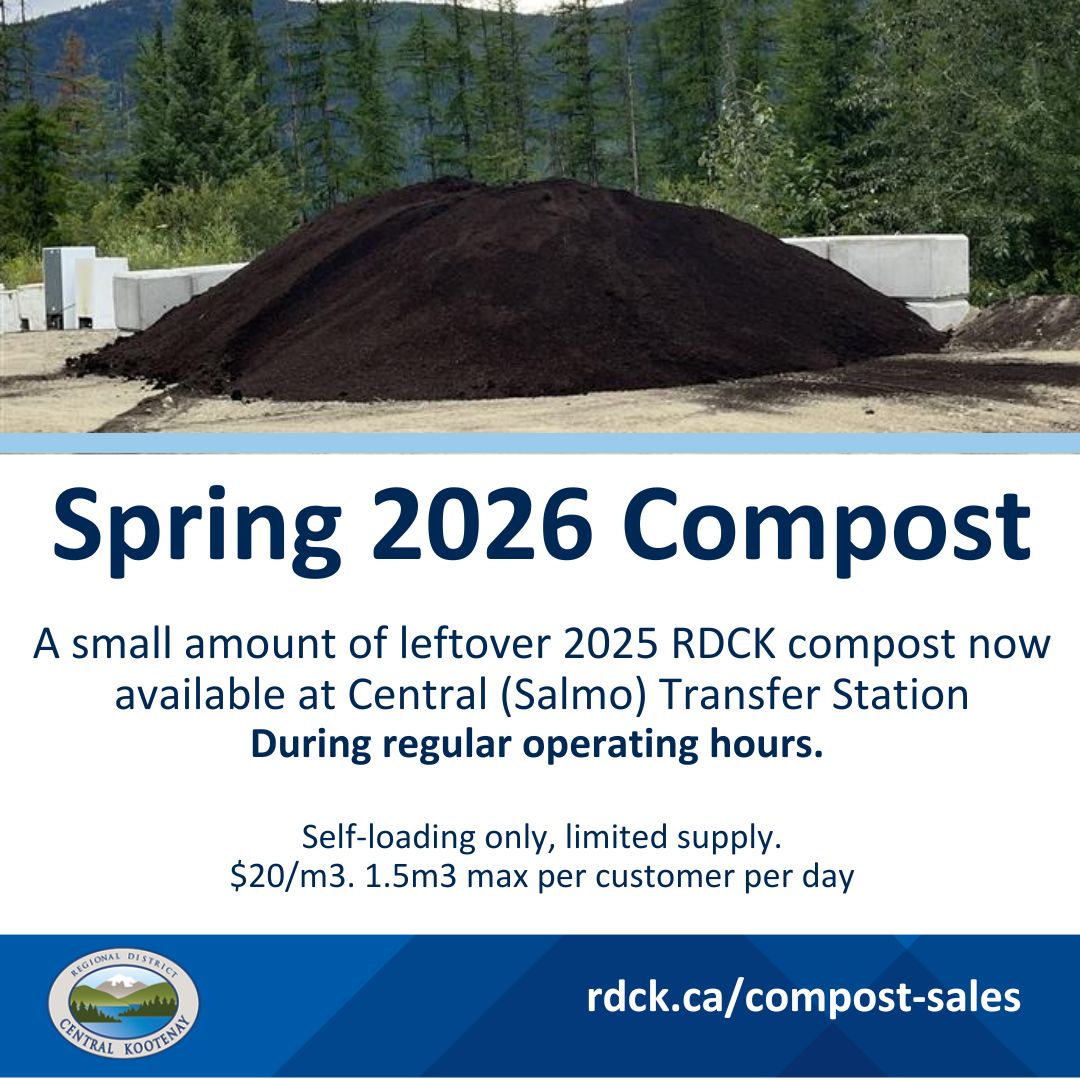
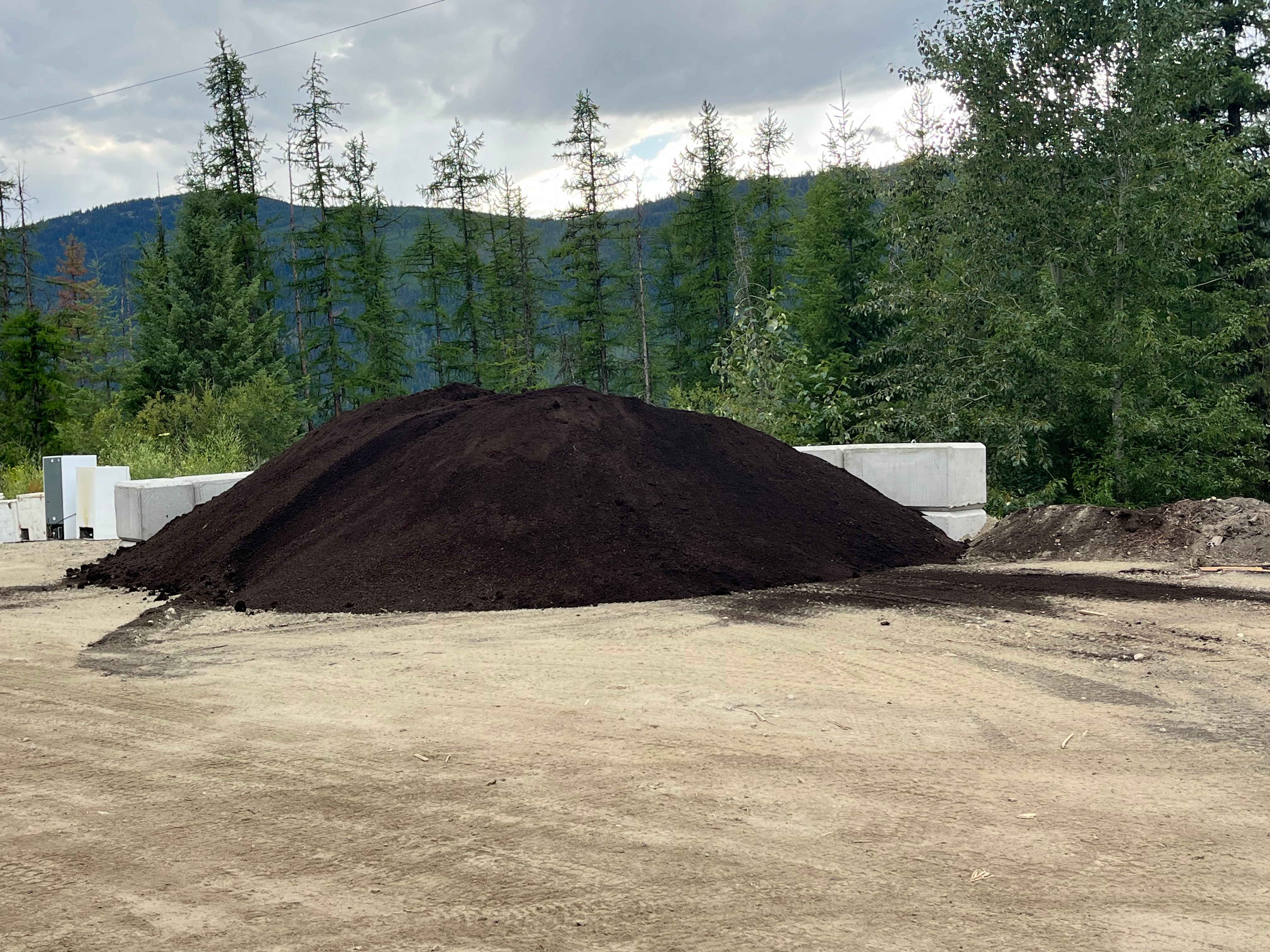
The RDCK would like to thank everyone that purchased compost in 2025 from the RDCK. A successful first-time compost sale period distributed over 600 cubic meters to residents and farms throughout the RDCK between August and December. A small amount of compost will be available in early 2026 at the Central Transfer Station, with another larger sale event in the fall of 2026.
Nelson, BC: Effective January 2, 2026, the Regional District of Central Kootenay (RDCK) will accept grant applications for the Columbia Basin Trust (the Trust) Resident Directed Grants (ReDi).
The program supports local projects that provide additional value to Basin communities. ReDi Grants are intended to be flexible and incorporate community-based funding decisions. The program is funded by the Trust and delivered in partnership with local governments and First Nations in the Basin, including the RDCK.
“Our community continues to benefit from the vital role Columbia Basin Trust plays in supporting and building up local projects in our area,” said Aimee Watson, RDCK Board Chair and Electoral Area D Director. “We look forward to seeing the submissions and having our many communities participate in the engagement process that the ReDi program requires.”
Last year, 322 applications were received, of which 313 were approved. The majority of projects that received funding were supporting cultural, social, environmental and economic projects.
The granting allocation for the RDCK for 2026 – 2027 is $1,409,849.00.
Click here to find more information about the Columbia Basin Trust ReDi Grants, including, who is eligible and how to apply. The deadline to apply is February 20, 2026 at 4:30 pm.
RDCK purchases land to create future community regional park in the Creston Valley
The RDCK purchased 3823 Goat Canyon Road in Electoral Area B for the development of a community regional park in the Creston Valley. The acquisition of the 4.4-acre property was made possible through contributions from Columbia Basin Trust ($540,000), BC Parks Foundation ($200,000), and the RDCK ($159,000). The property will become a future regional park and re-open long-term public access to the Goat River. The purchase also supports the RDCK, Town of Creston, and Electoral Areas A, B, and C Parks and Recreation Master Plan’s goal of adding parkland for the community. Over the next year the RDCK will complete a full risk assessment and begin developing a management plan to guide access, safety, and environmental protection. Click here for further details, including a map and photo of the property.
Construction Demolition Renovation Waste Multi-Material Diversion Pilot
The Board directed staff to proceed with Construction Demolition Renovation Waste Multi-Material Diversion Pilot (The Pilot) at the Nakusp Resource Recovery Facility in early 2026. The purpose of this pilot is to determine the viability of diversion programs for pane and automative glass (glass packing is already available at RDCK recycling depots) and drywall waste.
The objective of the pilot will be to recycle drywall into new drywall, which has been a common practice in larger centres for years, and is available in many other regions in BC. As well, recovered automotive and window pane glass will be crushed and used as cement additive, which significantly reduces embodied Greenhouse Gases generated in cement making.
Piloting CDR diversion onsite at Nakusp offers an opportunity to trial alternative resource recovery models for rural transfer station locations. If successful some of the diversion services may become permanent, and potentially expand to other facilities in the region.
The pilot is funded through $10,000 from the City of Nelson’s Low Carbon Homes Initiative Fund and $10,000 from the RDCK’s Local Government Climate Action Program funds.
Letter of Opposition – Bill M 216 – Professional Reliance Act
The Board approved sending a letter of concern/opposition to the Ministry of Housing and Municipal Affairs regarding Bill M 216 – 2025 Professional Reliance Act.
Bill M 216 is intended to reduce perceived duplication in local government oversight of construction, but contains multiple interpretations and could undermine public safety, bylaw compliance, and local government liability protections. If approved, the Bill requires local governments to accept certified submissions from professionals without meaningful review. The Bill assumes these professionals possess detailed knowledge of complex, jurisdiction-specific bylaws and prevents local governments from rejecting non-compliant plans early in the permit process. This could result in buildings constructed in violation of bylaws, costly retroactive fixes, and delayed responses to serious safety issues where peer reviews are urgently needed. Further, the Bill’s narrow and unclear liability protections leave local governments exposed, especially since many professionals carry limited, claims-made insurance that may not respond when construction defects emerge.
Tipping fees increased at RDCK facilities
The Board adopted Resource Recovery Facility Regulatory Bylaw No. 3065, 2025 which includes a 6.4% increase to most tipping fees. Organic waste products tipping fees will increase by just 2.4%. These changes go into effect January 1, 2026.
The 6.4% increase is a combination of a 2.4% increase to address inflation, plus a 4% increase planned each year, over the next five years in an effort to achieve cost recovery; managing waste largely through tipping fees, rather than taxation, is aligned with the RDCK’s goal to operate a user pay system.
In addition, mattresses will now be charged a per-unit rate of $17.50 each. The switch to a “per unit” rate for mattresses is in part a response to the exclusion of mattresses from the Recycling Regulation update in 2025. The RDCK and many other regional districts continue to lobby the province to include mattresses in the Recycling Regulation.
The Board appointed RDCK Directors to external committees for varying terms, as requested by the external agencies. These appointees represent regional interests on external bodies that deal with specific matters and issues relevant to local stakeholders. These committees include:
Municipal Insurance Association of British Columbia – Director Keith Page
Columbia Basin Trust Board of Directors – Director Suzan Hewat
Regional Invasive Species Working Group – Directors Suzan Hewat and Kelly Vandenberghe
Selkirk College Regional Innovation Chair for Rural Economic Development – Director Aidan McLaren-Caux
Ktunaxa/Kinbasket Treaty Advisory Committee – Director Arnold DeBoon
Municipal Finance Authority – Director Suzan Hewat
West Kootenay Transit Committee – Directors Diana Lockwood, Maria McFaddin, and Walter Popoff
Long Term Service Awards
The Board recognized and thanked 31 employees for their long-term service to the RDCK.
Long Term Service Award recipients with Board Chair Aimee Watson (Top Left – Rob Chernenko, Top Right – Chris Lehnert, Bottom Left – Tom Dool, Bottom Right – Stuart Durning)
Stuart Durning – 30 years
Bill Kootnikoff – 25 years
Sheila Kootnikoff – 25 years
Tom Dool – 20 years
Cody Peck – 20 years
Rob Chernenko – 20 years
Sangita Sudan – 15 years
Allan Richardson – 15 years
Gordon Jameson – 15 years
Chris Lehnert – 15 years
Darryl Zol – 15 years
Ryan Ricalton – 10 years
Jay Colley – 10 years
Jesse Wetter – 10 years
Paula Hudson-Lunn – 10 years
Connie Saari Heckley – 10 years
Jeff Phillips – 10 years
Lisa Dear – 10 years
Lynn Anderson – 5 years
Corey Scott – 5 years
Abby Beaudry – 5 years
Craig Stanley – 5 years
Nadine Trottier – 5 years
Glenn Wright – 5 years
Pam Malekow – 5 years
Karin Jorgenson – 5 years
Taylor Menzies – 5 years
Steve McCrea – 5 years
Mike Dalgleish – 5 years
Justin Niminikin – 5 years
Dan Elliott – 5 years
Tanya Gordon appointed to the RDCK Board of Directors
Effective January 1, 2026, Mayor Tanya Gordon will replace Councillor Leah Main as the representative from the Village of Silverton on the RDCK Board of Directors. Main will assume the role of Alternate Board Director for the Village of Silverton.
The Board would like to thank Director Main for her dedicated service and leadership as a longstanding advocate for rural communities as a member of the RDCK Board of Directors for over a decade. A former Federation of Canadian Municipalities Board member as well, Director Main’s commitment, insight, and collaborative approach has made a lasting impact on our region.
(Pictured: Board Chair Aimee Watson and Leah Main)
Director’sReports
RDCK Directors provide monthly reports outlining what they have been working on. Click here to read the December reports in the Board minutes.
RDCK Quarterly Report
For the latest RDCK Quarterly Report, which details the current projects and initiatives of the RDCK, please follow the link.
Nelson, BC: The Regional District of Central Kootenay (RDCK) is excited to share it has purchased 3823 Goat Canyon Road in Electoral Area B for $899,000. The 4.4-acre property will become a future regional park and re-open long-term public access to the Goat River, supporting the RDCK, Town of Creston and Electoral Areas A, B & C Parks and Recreation Master Plan’s goal of adding parkland for the community. Securing this land marks an important step in re-establishing a community gathering place cherished by generations.
“It’s exciting to see our efforts to acquire parkland for the community come to life,” said Roger Tierney, RDCK Electoral Area B Director. “This acquisition represents an important step toward improving parkland access in the region. As we move into planning, it is important that we hear from residents to help shape the future of this regional park, while also continuing our engagement with the Yaqan Nuʔkiy.”
While the land is now publicly owned, it is not yet open for public use. A full risk assessment must be completed, and any identified risks mitigated, before the public can safely enjoy the park. Over the next year, the RDCK will complete these site assessments and begin developing a management plan to guide access, safety, and environmental protection.
Residents will have opportunities to provide input as planning for the future of the park moves forward. The RDCK will share engagement details once they have been determined. The RDCK has also been in contact with Yaqan Nuʔkiy throughout the acquisition and will continue their engagement as planning advances.
“We’re grateful to our partners for their support in making this acquisition possible,” said Tierney. “Without their contributions, this purchase wouldn’t have been feasible.”
Photo Credit: BC Parks Foundation
The land acquisition was made possible through contributions from Columbia Basin Trust ($540,000), BC Parks Foundation ($200,000), and the RDCK ($159,000).
“Restoring access to the Goat River has long been a community priority, and we’re pleased to help make this important step possible,” said Katie Kendall, Senior Manager, Delivery of Benefits, Columbia Basin Trust. “We look forward to seeing the RDCK, Yaqan Nuʔkiy, and the community shape the future of this cherished place.”
“Adding this land to the public trust is a real win for the Creston Valley and we are happy to have played a role in making it happen,” says Andy Day, CEO of BC Parks Foundation. “It sets the stage for a future regional park where people will be able to swim, paddle, and spend time by the Goat River in a beautiful place. Parks like this improve people’s mental and physical health, boost the local economy, and are good for nature.”