
Government
About the RDCK
Board of Directors
Elections & Assent Voting
Financial Information
Our Community
Meetings
Parks & Recreation
Recreation
Facility Rentals
Services
Building Department
Community Sustainability
Emergency Management
Fire and Emergency Management Services
Land Use and Community Planning
Mapping and GIS
Waste & Resource Recovery
Water Services

Search RDCK
Environmental Services
Compost Sales
Fall 2026 Update
UPDATE: Machine Loading Available at Central Transfer Station on November 21, 25 and 28.
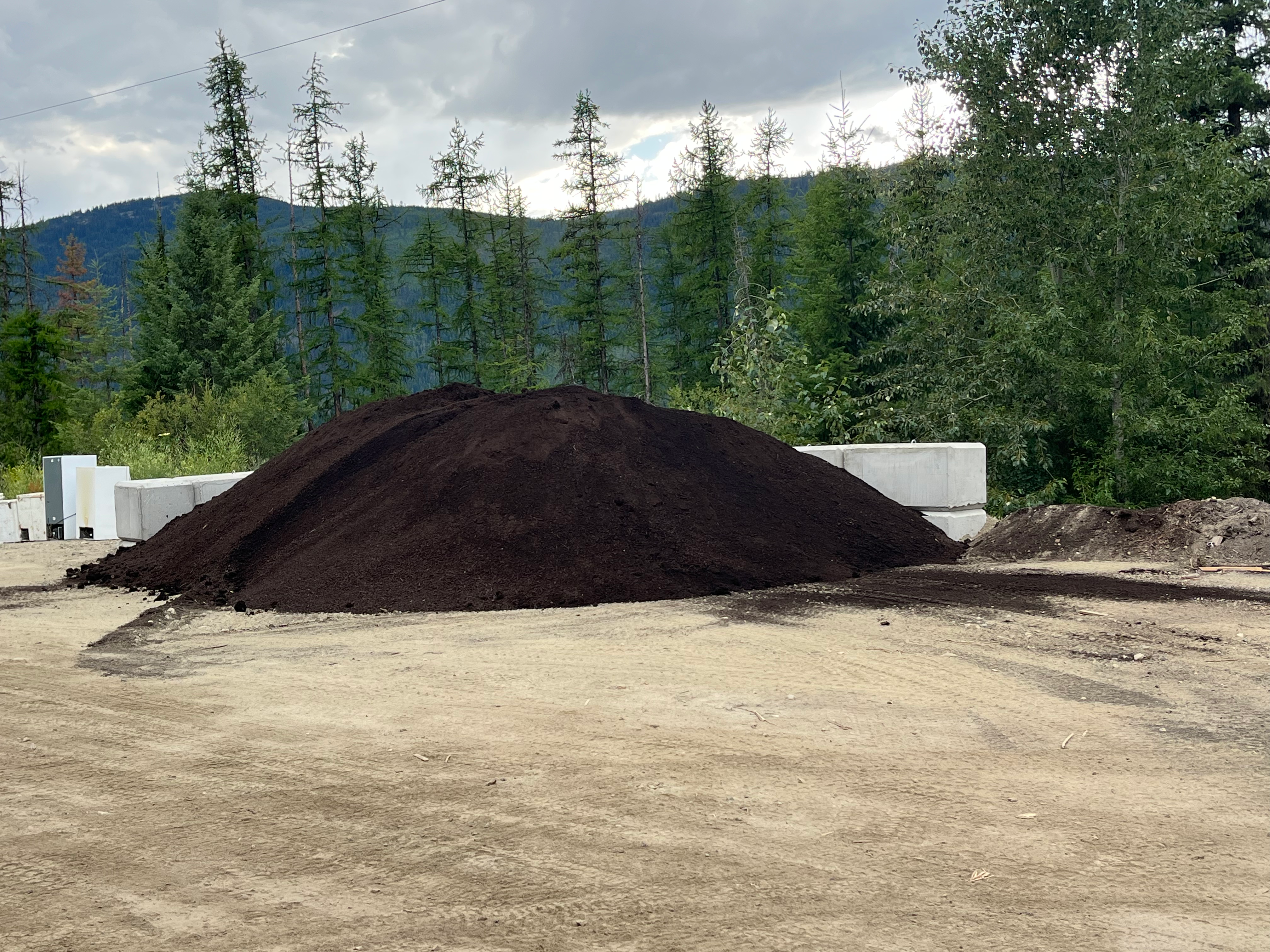
Compost is available for purchase at Central Salmo Transfer Station and Ootischenia Landfill – see below for details.
Compost is available at the Central (Salmo) Transfer Station and Ootischenia Landfills only. We anticipate Creston sales to be available in the early spring, 2027.
Material is available for self-loading during regular hours until weather prevents sales (snow and freezing temperatures). Ootischenia Landfill will be stocked with compost for Self-Loading until further notice. Bulk purchasers of compost (>10m3) at Central are welcome – call to arrange.
Loads 2 m3 or less are charged by volume to the nearest 0.25 m3 – visually estimated. Loads 0.25 m3 or less are charged the minimum rate. Loads greater than 2 m3 are charged by weight. Please call to arrange a commercial bulk purchase (i.e. dump truck) to ensure operator and product availability. Commercial bulk purchases (>10m3) available Tues-Sat, 8:30am to 3:00pm.
| Volume Price (for sales 2 m3 or less) | Weighed Price (for sales greater than 2 m3) |
| $30 per cubic meter (m3) | $50 per tonne |
| Minimum Rate: $7.50 (for 0.25m3 or less) | Minimum Rate: $5.00 |
| Site | Opening Day | Hours of Operation (CLOSED on Stats) | Available Sales Methods |
| Central Salmo Transfer Station | September 16 | Wed AND Sat; 10:00am to 2:00pm | Self loading. Machine loading available. Commercial bulk sales (>10m3) available. Contact to arrange: rrdept@rdck.bc.ca; 250-352-8161 |
| Ootsichenia Landfill | September 17 | Mon to Sat; 8:30am to 5:30pm (until Nov 1, then Winter Hours) | Self-loading only. Max 2 m3 per customer per day. FCFS, while supplies last. |
| Creston Landfill | Early Spring 2027 | Tue to Sat; 9:00am to 3:00pm | Check back for details – sales expected in Spring, 2027 |
What is the Compost?
- RDCK compost is a soil amendment used to support plant growth. It is not soil itself, so it should be properly applied for good results.
- It is not being marketed as a fertilizer, as we are not guaranteeing nutrient analysis of the compost
- The compost is fully matured.
How should I use it?
- We recommend mixing it well into gardens or applying it as a top dressing on lawns. It is “nitrogen rich”, like manure.
Has it been tested?
- It is Class A Compost tested by an accredited laboratory (A&L Canada Laboratories) Class A standards are set by the Province under the Organic Matters Recycling Regulation (OMRR). It’s been tested and passed for:
- Heavy Metals
- Pathogens (e.g., coliforms)
- Sharps and foreign matter (plastics, glass etc.)
- It is safe for use in home and agricultural food gardens and for landscaping.
- The label handout has recommended uses and other details.
- Compost should be free from weed seeds, but the RDCK does not guarantee the absence of weeds. There is information on the label handout.
Where was it made?
- Compost was produced at the Central Composting Facility near Salmo.
- It was made using the collected organic waste from municipal, residential, and commercial organic waste received at OOT, GRO, and CEN.
- Inputs are food waste, yard and garden, chipped clean wood.
We welcome user feedback on the performance of the compost – send to organics@rdck.ca.