Category: Uncategorized

Board Meeting – May 2022 Highlights

Kaslo infoNet Society – Connecting the West Shore of Kootenay Lake

Issac Maxfield, Executive Director of Kaslo infoNet Society (KiN), appeared as a delegation at May’s RDCK Board Meeting. The not-for-profit internet service provider is in the process of bringing fibre optic internet service to most communities on the West Shore of Kootenay Lake, north of Ainsworth. With grant funding from the likes of the RDCK and Columbia Basin Trust, Maxfield updated the Board on how KiN is expanding into Johnsons Landing and Argenta this year and into Meadow Creek and Cooper Creek next year. KiN is looking to expand into other areas within the RDCK to improve connectivity across rural areas.

Columbia Basin Trust – Community Initiatives Program/Affected Areas Program Grant Funding

The Board approved the 2022 Columbia Basin Trust Community Initiatives and Affected Area Program (CIP/AAP) grant funding. A total of $1,453,038.72 in funding will be allocated to 266 different project proposals. Click here for a complete list of all the recipients of CIP/AAP funding. The programs support local projects that provide additional value to Basin communities, and that benefit the broad community and public good.

Area E Library Contribution Service

A library financial contribution service bylaw for Electoral Area E will now be submitted to the Local Government Inspector for approval. When approved, staff will present the Board with a recommendation to public consultation and elector approval by means of the Alternative Approval Process (AAP). If adopted the contribution service will provide funding to the Nelson Municipal Library, while contributing to the overall literacy of the community and ensuring access to information resources. Currently, Electoral Area F and defined portions of Electoral Area H have a library contribution agreement with the Nelson Municipal Library.

2022 General Local Government Elections

In coordination with Elections BC, the RDCK has released its schedule of significant dates and statutory requirements for the 2022 General Local Government Election. Important dates to keep in mind, include:

  • August 30 – September 9 – Nomination Period
    • The period for candidates to submit their nominations to local election officials
  • September 17 – October 15 – Campaign Period
    • The period begins on the 28th day before General Voting Day and ends at the close of voting on General Voting Day.
  • September 19 – Declaration of Election by voting or acclamation
  • October 15 – General Election Day
  • November – Inaugural RDCK Board Meeting

 For more information and other important deadlines checkout pg. 258 of the May Board Addenda or go to the 2022 General Local Elections page of the Elections BC website.

Directors Reports

RDCK Directors provide monthly reports explaining what they have been working on. Click here to read the May reports in the Board minutes (agenda item 4.4, pg.128).

Click here to view a print-friendly PDF version.

Fortis and RDCK warn that high lake levels are expected over the next few weeks

NELSON, BC — FortisBC Inc (FortisBC) and the Regional District of Central Kootenay (RDCK) are notifying property owners along Kootenay Lake that due to above normal snowpack and delayed melt, there is an increased possibility that flooding could occur during late May or early June if temperatures rise substantially.

As of May 19, the lake level at Queen’s Bay was 1743.52 feet. It’s expected to rise two to three feet over the next week. Although lake levels are forecasted to remain below the 1752-feet flood level, the lake is subject to large natural inflows of water as a result of melting snow pack and precipitation. This means conditions could change suddenly over the next few weeks.

Power generation facilities like FortisBC’s Corra Linn Dam play a key role in managing lake levels. Since the beginning of March, FortisBC has discharged the maximum amount of water from Corra Linn. However, at this time, Grohman Narrows, a natural geological formation located upstream of FortisBC facilities, is restricting water flowing out of Kootenay Lake.

Residents and businesses along Kootenay Lake are encouraged to keep a close eye on lake levels over this period, assess what impact rising lake levels may have on their property and be prepared in the event there is a sudden rise in lake level. FortisBC provides daily updates on current and forecasted lake levels. For the most current information and to sign up for lake level notices, visit fortisbc.com/lakelevel.

Now is the time to be flood prepared. Residents should take the necessary steps to protect their home and property. Know the risks, have a plan and have an emergency kit. For more information and sandbag locations go to rdck.ca/befloodprepared. To sign up for emergency notifications on floods and other local emergencies in the RDCK, visit rdck.ca/emergencynotification. To report a flood emergency contact the provincial coordination centre at 1-800-663-3456.

Click here to view a print-friendly PDF version.

Local Government Awareness Week – May 15-21, 2022

This week marks Local Government Awareness Week (May 15-21) across British Columbia. The goal is to generate awareness and educate the public about the roles and responsibilities of local government and encourage the public to participate in local government processes.

Local government is an accessible and responsive level of government. Regional boards and municipal councils are local citizens elected by the community and local government staff are members of the community as well.

Photo courtesy: Dave Heath Photography

What is a Regional District?

A regional district is a federation of rural areas, municipalities and in some cases First Nations empowered to work together to plan, provide services and deal with issues on a regional scale.

In 1965, the province created regional districts to act as general local government for electoral areas. Regional districts provide rural residents with an effective form of local government, while also representing municipal residents on regional issues. They ensure all residents have access to commonly needed services, no matter where they live. Rural areas make up approximately 13 percent of the total population of BC.

Regional districts are governed by a Board of Directors composed of a director elected from each electoral area and one director appointed from the elected council of each municipality. The directors from the electoral areas serve for a four-year term, while municipal directors serve until the appointing body decides to make a change. The Regional District of Central Kootenay (RDCK) features 11 electoral areas and nine municipalities (Castlegar, Creston, Kaslo, Nelson, Nakusp, New Denver, Salmo, Silverton, and Slocan).

The RDCK is one of 28 regional districts in British Columbia and provides over 180 services including: GIS, Planning and Land Use, Community Sustainability, Fire Protection, Emergency Services, Animal Control, Regional Parks, Recreation Facilities, Water Systems and Waste and Recycling facilities.

The mission of the RDCK is to provide the area and communities with services, governance and representation in a manner that supports the economic, social and environmental goals of the region.

Here are some other resources to learn more about local government:

Local Government in BC: A Community Effort (overview of local government in BC)

Local Government in British Columbia – 4th Edition (complete overview of all levels of local government, from cities and regional districts to towns)

Regional Districts in BC

Learn more about the RDCK

RDCK wins two BC Economic Development Awards

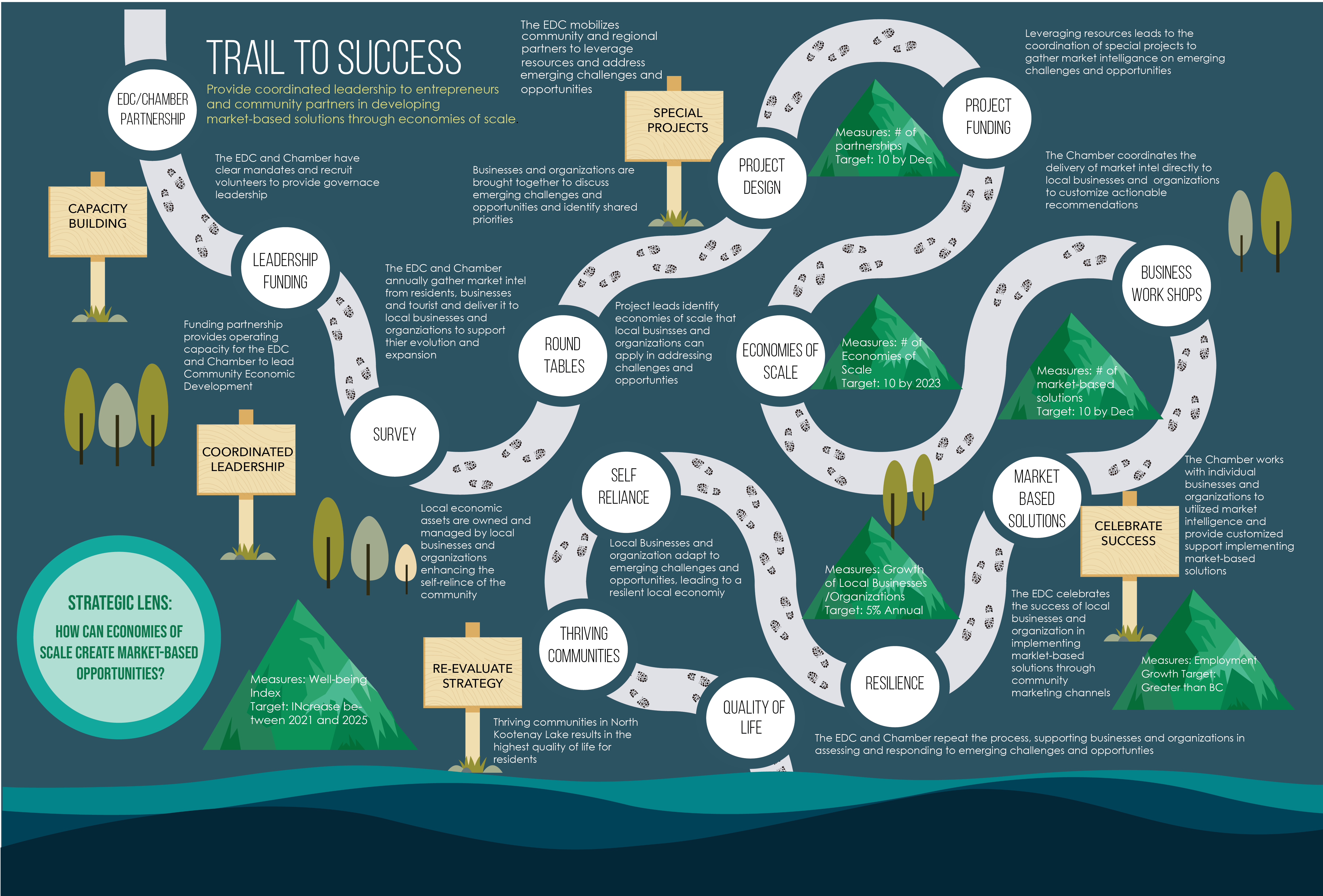
Nelson, BC: The Regional District of Central Kootenay (RDCK) was recognized for achieving excellence in economic development, winning two British Columbia Economic Development Association (BCEDA) awards for its community economic development strategy Coordinated Leadership: Community Led Economies of Scale. The strategy was developed for North Kootenay Lake by the Kaslo and Area D Economic Development Commission with funding support from the Government of BC and Columbia Basin Trust.

The BCEDA and FortisBC present the annual awards to BCEDA members who are doing outstanding work in supporting local economies and making a meaningful difference in their communities. The RDCK won the Community Project Award, recognizing an organization that has implemented various economic development initiatives that provide economic benefits to a community or region, and the Economic Recovery and Resiliency Award for projects that represent a successful recovery initiative from natural and man-made disasters, including COVID-19. Both awards were for a community with less than 20,000 population.

“As Mayor of the Village of Kaslo and Chair for the Kaslo & Area D Economic Development Commission, I am so proud of this project which is a great example of collaboration in our sub-region,” said Suzan Hewat, Mayor of Kaslo and RDCK Board Director. “The work being done by Factor 5 is helping to build much needed capacity and economic resilience in our area in partnership with local organizations in Kaslo and Area D.”

“Rural economic development is the baseline to a sustainable future,” said Aimee Watson, RDCK Board Chair and Electoral Area D Director. “Supporting the residents to ensure a healthy and accessible lifestyle requires thinking and acting outside of the box. From food security to supply chain innovations, this project and all of its endeavours not only brought many stakeholders together but achieved unique solutions and most importantly – a hopeful future that those here now and all those coming can succeed within our vast and rural landscape.“

In 2019 the Kaslo and Area D Economic Development Commission contracted the services of Factor 5 Group, a national social enterprise co-creating strong communities through excellence in economic development. Factor 5 worked closely with elected leaders, community volunteers and staff to co-create the unique community economic development strategy.

A few months into the process, the COVID-19 pandemic hit and business as usual came to halt. However, instead of putting the project on pause, the Commission worked with Factor 5 to kick in into high gear, mobilizing community leaders around response and recovery efforts, while maintaining the momentum of building a long term economic strategy for North Kootenay Lake communities. Hands on support was provided to the business community and an e-commerce platform (www.northkootenaylake.ca) was created to showcase local restaurants, grocers, retailers, as well as 40+ local service providers and local made products, heightening local spending. The result was immediate support for local businesses and a dedicated local community economic development coordinator who now leads ongoing projects in coordination with community partners.

“The key lesson to be learned from these awards is that villages and surrounding rural communities can pursue excellence in economic development with the limited resources they have available by coordinating leadership and activating the private sector, ” said Eric Burton, President and CEO of Factor 5 Group.

Since adopting the Community Leadership Strategy, the Kaslo and Area D Economic Development Commission has partnered with the Kaslo and Area Chamber of Commerce and other community partners to advance economic priorities, including buy local campaigns, business services, e-commerce support, agriculture incubation and supply chain management.

“This a boots on the ground approach to bringing together business sectors, resources and organizations, working to find solutions and being the solution when necessary,”  said Pat Desmeules, Kaslo & Area Chamber of Commerce Administrator. “The Kaslo & Area Chamber of Commerce is very pleased to be part of the great initiative and look forward to continuing to achieve the goals along the way of the Trail to Success!”

Click here to view a print-friendly PDF version.


Community input leads to a vision for Campbell Field

Nelson, BC:  Last November, the Regional District of Central Kootenay (RDCK) presented two high-level options for the reimagination of Campbell Field to the community for input. More than half of the people who provided input on the concepts (57%) said they preferred the option with a greater focus on outdoor elements. Based on the information gathered, a single concept was developed.

“I’d like to thank and acknowledge the community for participating in this process and providing insight into their vision for Campbell Field,” said Walter Popoff, Director of RDCK Electoral Area H. “This is still early days of the project, and there will be more conversations to come—especially with the students and staff at Mount Sentinel School. But I believe that what is presented in this concept will support the recreation goals of the community, for now and for generations to come.”

The two high-level concepts were developed based on a previous community survey. Option 1 had a greater focus on the indoor elements, and Option 2 had a greater focus on outdoor elements. Between November 22, 2021 and January 5, 2022, the concepts were available for viewing at a number of community locations and on the RDCK website. A virtual public information session was hosted on December 5, during which the two concepts were presented. A total of 375 comments were gathered though this process.

Overall, respondents indicated that a multi-activity development that makes use of outdoor amenities, while providing some respite from the weather in all seasons, would be the best fit for the community. The updated concept includes the following features: full-size soccer field, track and field amenities, field house, basketball and tennis courts, splash pad, skate park, bike pump track, and park space.

The involvement of the community and youth will continue to be a priority as the project progresses. Gathering more detailed information about potential use is vital, as are partnerships with schools and community organizations.

At this stage, the project moves from the strategic planning phase of the process into the tactical planning phase. Tactical planning includes exploring the impacts and options of the development, the capital and operating financial implications, the development of an operational plan, and the recommended course of action to develop the project. Further direction from the RDCK Board of Directors and input from the community will be sought at key points as the project moves forward.

The community is invited to review the updated concept and the feedback report, “Campbell Field Feasibility Study: Concept Development,” on the RDCK website at www.rdck.ca/CampbellField.

Located at the Playmor Junction, adjacent to Mount Sentinel Secondary School and the Slocan Valley Rail Trail, Campbell Field was gifted to the RDCK in 2016 by the South Slocan Sports Association. In the fall of 2020, the RDCK initiated public engagement through surveys and consultations to learn about the community’s priorities and preferences for indoor and outdoor recreation. Previous reports and the two high-level concepts are also available on the project web page.

Click here to view a print-friendly PDF version.

RDCK Emergency Notification System Test

Nelson, BC:  In recognition of Emergency Preparedness Week (May 1-7), the Regional District of Central Kootenay (RDCK) will be conducting its annual TEST of the Emergency Notification System on Tuesday, May 3rd at approximately 12:00 pm. Anyone registered with the RDCK’s Emergency Notification System, will receive a TEST notification via mobile phone (text), email, landline call, or Voyent Alert! app, depending on which option you chose when you signed up.

Emergency Preparedness Week, a national awareness initiative that has taken place every year since 1996, is an opportunity to take action to ensure you are prepared to protect yourself, your family and your community during an emergency.

If you are new to the area, or have not yet signed up for emergency notifications, please go to www.rdck.ca/notifications. To ensure you receive important emergency information relevant to your location it is imperative residents update their account with the most accurate location information. Please take this opportunity to login to the system and double check your details www.rdck.ca/notifications.

“We encourage all residents throughout the RDCK to sign up for our emergency notification system to ensure they are receiving the most accurate and up to date information, “ said Chris Johnson, RDCK Manager of Community Sustainability. “Now is the time for all residents to prepare for emergencies by updating their emergency plans and prepare grab and go kits.”

The City of Nelson, which also uses Voyent Alert! as their Emergency Notification System, will also be running a TEST the same day. 

Everyone has a role to play in an emergency and Emergency Preparedness Week is a great opportunity for residents to take action:

Click here to view a print-friendly PDF version.

Board Meeting – April 2022 Highlights

Brittny Anderson, Nelson-Creston MLA, joined RDCK Board Meeting

Brittny Anderson, MLA for Nelson-Creston, appeared as a delegation at April’s RDCK Board Meeting. Originally elected as MLA in 2020, the former RDCK Board member encourages a strong partnership between local government and the provincial government. The list of topics covered included: connectivity, accessing emergency services, watershed governance, wildfire mitigation, rising building costs, and parental leave for government officials.

Proof of vaccination policy for RDCK employees rescinded

Effective immediately, the Board rescinded the proof of COVID-19 vaccination policy for all RDCK employees. The policy, originally adopted November 18, 2021, provided enhanced safety measures to mitigate the potential spread of COVID-19. The BC Government lifted its provincial proof of vaccination requirement April 8.

RDCK employees will continue to follow masking protocols, wearing masks in public and common places in all RDCK offices and facilities.

Remuneration bylaw amendment – Parental leave

Understanding the importance of attracting and retaining young people to local government positions, the Board adopted an amendment to the Chair, Directors and Alternate Directors Remuneration Bylaw which entitles a Director parental leave for a period up to six months with continued payment of their regular stipend. The amendment also includes reimbursement for child care expenses in order for a Director to attend an in-person meeting.

Regional Recreation Allocation Policy

The Board adopted the Regional Recreation Allocation Policy effective immediately. The policy is a guideline for determining the amount of time that is given to groups or individuals for the use of recreation and cultural facilities and spaces. Not only is the policy based on need/demand for a service, but who benefits from the service, as well as number of users, length of rental season, and revenue. The framework will allow staff to be able to consistently and equitably evaluate and justify need and distribution of available hours.

New Election and Assent Voting Bylaw

The Board adopted the Election and Assent Voting Bylaw replacing the Local Government Elections & Other Voting Conduct Bylaw from 1993. Based on a template from the Local Government Association of British Columbia the new bylaw is in compliance with the Local Government Act, authorizes the use of the provincial voters list, authorizes the use of mail in ballots, allows for additional advanced voting opportunities, and improves the overall efficiency of the election process. The RDCK will be holding local government elections in October 2022.

Utility Rates, Fees and Charges

The Board adopted the Utility Rates, Fees and Charges Bylaw which repeals and replaces the existing bylaw. The new bylaw implements the 2022 water service financial plan which will see water user rate increases for 17 of the 18 RDCK water systems. The rationale for rate increases include operations and maintenance costs, environmental service fees, and increased contributions to reserves. New rates are in effect as of January 1, 2022 for both quarterly metered and annual flat rate water utility service bills.

For more information go to www.rdck.ca/water

Salmo and Electoral Area G Library Contribution Service

An expanded service bylaw for Salmo and Electoral Area G library services will now be submitted to the Local Government Inspector for approval. When approved, staff will present the Board with a recommendation to public consultation and elector approval by means of the Alternative Approval Process (AAP). If adopted, the contribution service will expand the library services to all of Electoral Area G and create sustainable funding from rural areas to local library services located in municipalities, while reducing taxation for current rate payers.

Electoral Areas E and F Dog Control Contract

The Board awarded the Dog Control Officer contract for Electoral Areas E and F to Bill Hitchon. As well, the Board appointed Bill Hitchon and his alternate Dr. John Dale as Dog Control Officers for enforcement in Electoral Areas E and F. The role of the Dog Control Officer is to enforce the provisions of the Dog Control Bylaw, including: provide dog control services, respond and investigate all complaints to alleged violations of the Dog Control Bylaw, provide patrol services, deal with all emergency calls related to dogs and be the pound keeper for the service area.

New roof for RDCK head office in Nelson

The Board awarded the construction services for the roofing replacement project for the RDCK head office in Nelson to Alfred Horie Construction Company Limited. The scope of the work includes replacing the end of life rooftop HVAC (heating, ventilation and air condition) units and replacing a portion of the roofing system. The existing roofing system has been failing for the last two years, with multiple leaks causing minor damage and a loss of work space. The project is expected to be completed by the end of the 2022, contingent on the delivery time of the new rooftop units.

West Creston Fire Hall

The Board awarded the contract for the West Creston Fire Hall Construction to ZKO Construction Ltd. The RDCK has a budget of $700,000, including a $90,000 contribution from the West Creston Fire Protection Society, for completion of the project by ZKO Construction Ltd. The project will benefit the residents in the West Creston Area and Area C by providing rapid response to fire and emergency situations occurring in the service area. The project is expected to be completed by November 30, 2022.

RDCK Quarterly Report

The Board received the 2022 Q1 Quarterly Report which details the current projects and initiatives of the RDCK. Please follow the link to the most recent RDCK Quarterly Report.

Directors Reports

RDCK Directors provide monthly reports explaining what they have been working on. Click here to read the April reports in the Board minutes (agenda item 4.4, pg. 138).

Click here for a print-friendly PDF version.


Post wildfire natural hazards risk analysis – Cultus Creek wildfire

Nelson, BC:  The Province of British Columbia’s Ministry of Forests (Previously known as Ministry of Forests, Lands, Natural Resources Operations and Rural Development), has released its post wildfire natural hazards risk analysis reports for the Cultus Creek wildfire from 2021. This report contains information on potential hazards and risks following a wildfire, such as downslope and downstream risks to life, property and infrastructure. To view the report click www.rdck.ca/hazardreports.

Following a wildfire, the chances of soil erosion, landslides, and floods can increase. This risk can be enhanced with intense rainfall or rapid snowmelt. To better understand the risk, the Ministry of Forests conducts post wildfire analysis of the hazard areas that can affect residents.

“While this is not a heavily populated area, there are a number of recreational properties and an important supply line via the railroad that were impacted,” said Chris Johnson, RDCK Manager of Community Sustainability. “The information provided by the Ministry of Forests advises how conditions may have changed as a result of the wildfire, and we encourage residents or anyone planning to visit the area this year to update their emergency plans accordingly.”

For information on emergency preparedness, visit emergency management in B.C.

2021 was an unprecedented year for emergencies. The Cultus Creek wildfire was first discovered on July 2, 2021 on the west shore of the south arm of Kootenay Lake within the Kootenay Lake Provincial Park. As a result, residents and recreation sites in Electoral Area A in the Midge Creek to Next Creek area were on Evacuation Order between July 23-25.

The Post Wildfire Natural Hazard Risk Analysis reports for previous wildfire events are also available on our website at: www.rdck.ca/hazardreports.

The RDCK encourages residents to remain prepared for unexpected events or emergencies by making a plan and having a household emergency kit and a grab and go bag. As well, it is recommended for residents to exercise extreme caution in areas below recent wildfires and near creeks. Following a wildfire, the likelihood of the occurrence of landslides, erosion, floods and snow avalanches within or downslope of the burned area can increase.

For more information about emergency preparedness, along with other resources:

To report floods or landslides, contact Emergency Management BC at 1.800.663.3456

 Click here to view a print-friendly PDF version.

Proof of vaccination no longer required to access RDCK recreation centres

Nelson, BC:  Following the announcement from the Provincial Health Officer (PHO) earlier this week, the Regional District of Central Kootenay (RDCK) will no longer require proof of vaccination from members of the public to access and use RDCK recreation facilities and services, as of Friday, April 8, 2022.

Visitors to recreation centres are welcome to wear a mask during their visit if that makes them feel more comfortable.

“The lifting of the proof of vaccination requirement is great news because it means that BC’s vaccination efforts and other protocols are making a difference to overall hospitalization rates,” said Joe Chirico, General Manager of Community Services at the RDCK. “With COVID-19 still circulating in our communities, people are encouraged to do what they need to do to protect their health. Some people might want to continue to wear a mask in our facilities, and we encourage that. Please respect each other’s level of comfort and personal decision to wear a mask if that’s the case.”

The lifting of the proof of vaccination mandate applies to members of the public accessing RDCK facilities. Staff will continue to follow proof of vaccination and masking guidelines set by the RDCK Board of Directors and RDCK management.

Staff at recreation facilities continue to implement protocols to make spaces as safe as possible. This includes continuing to use barriers and/or physical distancing at customer service touch-points, focusing on providing a clean and healthy recreation environment, and making hand sanitizer/soap and water readily accessible.

“Our team is committed to making recreation accessible, and providing safe and fun recreation options for all members of the communities we serve—whether it’s in one of our fitness classes, aquatics centres, playgrounds or parks and trails,” said Chirico. “There really is something for everyone.”

If you have a question about making your visit as safe as possible, please contact your local recreation facility directly to ask about potential accommodation. Contact information can be found at www.rdck.ca/recreation.

Print-friendly version.

Preserving Cottonwood Lake for the next generation – A community comes together for a greater cause

Located just south of the City of Nelson along Highway 6 towards Salmo in Electoral Area ‘E’ of the Regional District of Central Kootenay (RDCK) is Cottonwood Lake. Known for its picturesque setting among the Selkirk Mountains, Cottonwood Lake is a recreation destination for residents of the RDCK.

While the community has benefitted from this outdoor playground for decades, what they did not probably realize is only a small portion of the land was actually owned by the RDCK, the rest was private land. Originally, the RDCK owned 0.7 hectares which amounted to the footprint of the beach and the parking area. However, when the private land owner started logging the land, the community mobilized and provided the RDCK with the support needed to buy the land. In 2019, the RDCK purchased 21.6 hectares of land, including land around the lake and the western flank, from the private land owner for $450,000. The purchase was partially funded with a $200,000 grant from Columbia Basin Trust (the Trust).

“The majority of the public assumed the land around Cottonwood Lake was crown land and therefore would remain as is,” said Joe Chirico, RDCK Community Service Manager. “However, with the threat of logging by the private land owner, the RDCK responded to the need of the community. We identified the land was appropriate to expand our park service and made a reasonable deal.”

“Cottonwood Lake is a recreation hub for rural areas and the city of Nelson, boasting the Nelson Salmo Great Northern Trail, fishing, mountain biking, and skating in the winter,” said Ramona Faust, RDCK Electoral Area ‘E’ Director. “As well, it is crucial wildlife habitat and home to old growth trees, estimated to be 300-400 years old, so it was important for the RDCK to help preserve the land and maintain its natural setting for locals and tourists alike to enjoy.”

Despite the purchase there was still another 49 hectares of private land in the area slated for logging. Concerns from the public ranged from land stability to wildlife habitat to the conservation of the popular recreation area. In response, the Cottonwood Lake Preservation Society (CLPS) was formed with the goal of raising enough money to purchase the land.

In 2019, the society negotiated a deal with the private land owner. It took all of 2020 and 2021 for the society to reach its fundraising goal which included additional funding from Fish & Wildlife Compensation Program ($75,000), Sitka Foundation ($75,000), the Trust ($60,000), the Conservation Alliance ($54,000), FortisBC ($20,000), Nelson & District Credit Union ($10,000), Royal Bank of Canada Foundation ($10,000), Kootenay Lake Conservation Fund ($10,000), RDCK Area E ($10,000), and close to 1,000 other individual groups and local business contributors. In turn, CLPS, along with the RDCK and the Nature Conservancy of Canada (NCC) set up a memorandum of understanding that the RDCK would purchase the land on behalf of the CLPS and then donate the land to NCC.

“These efforts show the power of community members who express their voices and then partner with organizations like the RDCK to achieve their goals,” said Will Nixon, Senior Manager, Delivery of Benefits, Columbia Basin Trust. “We were glad to be able to support these purchases, which are positively impacting ecosystems and community well-being through expanding a park and protecting its surroundings into the future.”

 “Without the support of the RDCK and the Trust, none of this would have been remotely possible,” said Andrew McBurney, Cottonwood Lake Preservation Society. “The community at large recognized the gravity of losing Cottonwood Lake and was hell-bent on making sure that it didn’t happen. It was heartwarming to see and feel the citizenry, young and old, come together. The entire community pitched in. There were silent auctions, music concerts, letter writing campaigns to local politicians, public pleas on CO-OP radio shows, open houses, emails and phone calls to all forms of media and it was all done with volunteer grit.”

“Full credit goes to the Cottonwood Lake Preservation Society for their commitment and hard work over the last number of years, “ said Chirico. “Following the RDCK Board’s approval of the land donation agreement to NCC at the March 2022 Board meeting the final step is to fulfill the commitment to ensure the lands are protected for conservation.”

NCC is Canada’s leading land conservation organization, having helped to protect 15 million acres coast to coast to coast. The not-for-profit land trust has been active in the RDCK since 1996, and will manage this land in perpetuity, with a focus on fire mitigation, mapping rare species and restoring ecological damage.

“This project offered a welcome opportunity to work in partnership with the Cottonwood Lake Preservation Society and the regional district to conserve the forested slopes around the Cottonwood Lake Regional Park,” said Richard Klafki, Canadian Rockies Program Director, Nature Conservancy of Canada. “Our staff will develop a long-term management plan that will be aimed at restoring and maintaining the conservation values of the land. We will also continue to collaborate with RDCK on a visitor use strategy that is in alignment with low impact recreation and safeguards the ecological values of the area.”

“At a time when we are bombarded with evidence that the natural world is crippling under the weight of what some call progress, it’s never been more critical to protect and preserve what little is left,” said McBurney. “We heard from many respected researchers and specialists on concerns for threatened grizzlies to fish, great blue herons, soil erosion, rising lake temperature, flood risks and avalanche hazards in the area. We are under no illusion that the preserved land at Cottonwood is somehow going to tip the balance in favour of Mother Nature, but it sure can help.”

                           Click on the image to enlarge

The investment in Cottonwood Lake Regional Park does not stop at the purchase of the land. There is $610,000 allocated for numerous improvements over the next year to upgrade the park to be accessible to all segments of the population – $213,000 from RDCK Areas E, F, and G Community Works Funding, $200,000 from the Kootenay Adaptive Sport Association, and $197,000 from TransCanada Trail Funding. Upgrades include two new observation viewing platforms (one on each side of the lake), enhanced parking, a new washroom facility, and the majority of trails will be brought up to a universal access standard. The lake will also continue to be stocked by Freshwater Fisheries Society of BC with approximately 2,000 trout a year.

“One of the biggest draws about living or traveling in the RDCK is the outdoor recreation and we understand the importance of investing in our parks and trails, not only to maintain and improve them, but also to make them accessible for everyone to have a great park experience,” said Faust.

The RDCK’s commitment to preserving parkland goes beyond Cottonwood Lake. Over the last 10 years the organization has made a concerted effort to expand parks and trails throughout the region. Since 2012, the RDCK has added seven regional parks totaling 106.8 hectares (Balfour Beach Regional Park, Crawford Creek Regional Park, Crescent Valley Beach Regional Park, Lardeau Regional Park, McDonalds Landing Regional Park, Morning Mountain Regional Park and Waterloo Eddy Regional Park) and acquired another 97 hectares of private land (Cottonwood Lake Regional Park, Crawford Creek Regional Park, Crescent Valley Beach Regional Park, Taghum Beach Regional Park and Waterloo Eddy Regional Park). In total the RDCK operates 26 Regional Parks (www.rdck.ca/parks), which include waterfront access parks, multi-purpose parks and regional trails. For those living in the RDCK, outdoor recreation is a top priority, so if there is private land for sale that has community value, the RDCK will support a community initiative to take a serious look at the opportunity to purchase the land to expand its network of parks and trails.

“We have seen an increase in usage of our parks and trails over the last two years, highlighting the demand in our region,” said Chirico. “In general there has been a significant amount of land acquisition across the province by local governments to meet the demands of its residents and we will continue to pursue opportunities if it is the right fit and in the interest of the community.”

For more information on the extensive parks and trails throughout the RDCK go to www.rdck.ca/parks.

Click here to view a print-friendly PDF version.

Ribbon-cutting at Castlegar and District Kids’ Club celebrates collaboration and care

Castlegar, BC: The new Castlegar and District Kids’ Club, located on the grounds of the Castlegar and District Community Complex, was celebrated at a ribbon-cutting ceremony on March 25, 2022. Local elected officials, provincial representatives and other special guests were on hand to acknowledge the collaboration that made the much-needed facility a reality. The Kids’ Club, which provides 30 licensed child care spaces for local families, was completed in late 2021 and opened its doors on January 4, 2022.

The event started with a blessing from Bev Gillard, Elder, and Crystal Laren, Program Consultant West Kootenay Region, from the Circle of Indigenous Nations Society (C.O.I.N.S). The blessing was followed by a drum song, and then remarks from local government officials and partners.

“We are excited and grateful to be celebrating the Castlegar and District Kids’ Club, and to be recognizing the partnership and collaboration that led to the creation of this much-needed facility,” said Kirk Duff, Mayor, City of Castlegar and Director, Castlegar and District Recreation Commission. “We’ve heard from parents and caregivers that the Kids’ Club is a solution to their child-care needs. That’s an outcome worth celebrating.”

The facility was made possible thanks to a partnership with Kootenay Family Place (KFP) and the Regional District of Central Kootenay’s (RDCK) Castlegar and District Recreation Commission (CDRC). It was funded by the Province of British Columbia’s ChildCareBC New Spaces Fund, which supports the new, licensed spaces in Castlegar.

“The child care spaces at this community facility will make a big difference to local people, especially as more and more young families have been moving here to raise their children. It’s great to see this project complete,” said Katrine Conroy, MLA for Kootenay West. “It’s part of a network of new quality centres that are helping to build a future where child care is a core service that families can depend on when they need it, and at a price they can afford.”

“We are proud to have partnered with the RDCK and the Province of British Columbia to secure a modern and much needed Early Learning Centre,” said Rebecca Vassilakakis and Marissa Carrasco, Kootenay Family Place Board Co-Chairs. “We are excited to expand Kootenay Family Place’s quality services through the Castlegar and District Kids’ Club making childcare even more accessible for families in our community.” 

Left to Right: Jim Crockett – Manager of Recreation CDRD/RDCK; Kirk Duff – Castlegar Mayor/CDRD Commission Director; Katrine Conroy – MLA for Kootenay West; Rebecca Vassilakakis – Kootenay Family Place (KFP)Co-Chair; and Sally Bojechko – Kootenay Family Place (KFP) Co- Executive Director. Photo credit: Jennifer Small

The 30 new spaces offered in the facility includes 20 licensed pre-school and 20 after-school spaces, providing part-time care in the mornings and after school. The community complex will have access to the facility for programming and school break camps when not in use for child care.

The child care centre was designed by Cover Architecture, a Nelson, BC-based architectural firm, and construction was led by Alfred Horie Construction (AHC) Co. Ltd. The facility is a standalone building situated across from the skate park adjacent to the complex pool, facing south. A new playground area was also created as part of the project, which is open to the public after child-care hours and on weekends.

KFP is a registered non-profit organization serving the needs of children, youth and families throughout the West Kootenay Boundary region. For more information regarding the child-care services that will be offered at the facility, contact KFP via email to childcare@kootenayfamilyplace.org.

View the print-friendly version.

Online engagement tool for Columbia Basin Trust Community Initiatives and Affected Area Program Funding (CIP/AAP) grants

Nelson, BC: Public engagement is an integral part of the Columbia Basin Trust Community Initiatives and Affected Areas Program Funding (CIP/AAP) process. For a third straight year the Regional District of Central Kootenay (RDCK) will use an online engagement tool, which will allow the public to provide their feedback on proposed projects for the area in which they live.

Public input into Salmo and Electoral Area G funded projects will be considered at an in-person meeting to take place in April. The location and date is to be determined.

The online public engagement period will be from March 28, 2022 at 8:00 am to April 8, 2022 at 4:30 pm.

To participate in the public engagement process, please visit the RDCK website at www.rdck.ca/cip-aap on or after March 28th.

In 2021, the online engagement tool was very successful as a total of eight thousand four hundred thirty five (8,435) entries were received, almost double from 2020. Once the public engagement period was complete, all feedback was shared with the adjudication committee of each of the 20 RDCK jurisdictions (11 electoral areas and nine municipalities) for their review and consideration. The adjudication committees then provided their recommendations to the RDCK Board of Directors.

Please note the online engagement tool is not a voting system, but a way for the public to provide the feedback on projects they feel are most important to the area they live in.

Click here to view a print-friendly PDF version.
Board Meeting – March 2022 Highlights

RDCK Adopts Five-Year Financial Plan

The RDCK Board adopted its 2022 – 2026 Financial Plan Bylaw, an annual requirement which must be completed by end of March each year. This year’s budget was focused on dealing with the continued impact COVID has had on the RDCK, in particular in recreation which has seen reduced user fee revenue over the past two years. Core services such as fire services, recreation and resource recovery have tax increases in 2022 with the RDCK in general seeing a 6.55% increase in taxation. Click here to view the financial plan (agenda item 8.6, pg. 262)

The RDCK hosted eight virtual public meetings and one in-person meeting through February and March which allowed the public in our various sub regions to comment and provide feedback on the five year Financial Plan.

City of Castlegar Economic Development Service Establishment

The RDCK Board has established the City of Castlegar Economic Development Service to address regional economic opportunities and challenges. The goal is to promote sustainable, diversified economic growth, work with and for all economic sectors, while supporting existing businesses, promoting alliances between businesses and encouraging new opportunities. With the support of local government and the community, local businesses can thrive and grow in the City of Castlegar.

Cottonwood Lake land transfer

The RDCK is proceeding with the next step of transferring 49 hectares of land near Cottonwood Lake to the Nature Conservancy of Canada (NCC). The land was acquired by the RDCK in 2021 as a result of fundraising efforts by the Cottonwood Lake Preservation Society (CLPS). The RDCK, CLPS and NCC developed a memorandum of understanding to work in collaboration to protect the natural habitats and ecological features occurring on the land. These next steps include publishing the intent to transfer the land in a local newspaper, paying all related expenses and the stewardship endowment, finalizing the closing dates and signing of the land donation agreement.

Cottonwood Lake Accessibility Project

The RDCK Board approved entering into a partnership agreement with the Kootenay Adaptive Sports Association (KASA) for the completion of the Cottonwood Lake Accessibility Project. The project will upgrade the park so it is accessible to all segments of the population. Work to be done includes ensuring accessibility to the following areas: parking, washroom facilities, wildlife nature viewing, fishing platforms, trails, footbridge and wharf.

The cost of the project will be $425,000. The Nelson, Salmo, Areas E, F, and G Regional Parks Service will cover up to $225,000 while KASA will contribute $200,000.

Public Library Contribution Services

The RDCK Board directed staff to take the next steps in expanding funding for library services in the region. An establishing bylaw for an Electoral Area E Library Contribution Service to provide funding to the Nelson Public Library will be prepared for Board consideration. Additionally staff will prepare a bylaw to expand the Salmo and Area G Library Financial Aid Service to include the entirety of Electoral Area G. This service currently funds library services within the Village Salmo. The objective of these contribution services is to create sustainable funding from rural areas for local library services located in municipalities and accessed by rural residents.  The adoption of both bylaws would be subject to public consultation processes and elector approval by means of the Alternative Approval Process (AAP).

Major upgrade for outdoor pool in Salmo

The outdoor pool at the Salmo Valley Youth & Community Centre will be undergoing a major upgrade. The RDCK Board approved entering a contribution agreement with Columbia Basin Trust for a $150,000 grant to replace pool heaters, the mechanical room and sanitization equipment at the pool. This is part of Columbia Basin Trust’s commitment to outdoor recreation assets in the area by providing grants to help communities improve facilities that support active, healthy lifestyles.

Ootischenia Fire Hall Expansion and Improvement Project

NDB Construction Ltd. has been awarded the design and construction services by the RDCK Board for the Ootischenia Fire Hall vehicle bay expansion and improvement project. An additional 720 square feet of space will be added to house rescue apparatus and address safety issues regarding insufficient space for equipment storage. The project will also include a new main entrance and energy efficiency work. The cost of the project is limited to a maximum value of $212,429 and is expected to be completed by the end of September 2022.

RDCK to donate to Canadian Red Cross Ukraine Humanitarian Crisis

The RDCK will contribute $5,000 to the Canadian Red Cross Ukraine Humanitarian Crisis Appeal to assist Ukrainian children and its citizens impacted by the ongoing conflict in the Ukraine.

Directors Reports

RDCK Directors provide monthly reports explaining what they have been working on. Click here to read the March reports in the Board minutes (agenda item 4.4, pg. 128).

Click here to view a print-friendly PDF version.

Partial closure of dock at Sunshine Bay Regional Park

The Regional District of Central Kootenay (RDCK) has closed a portion of the dock at Sunshine Bay Regional Park in Harrop due to safety concerns.

The boat launch is still open and accessible.

Repairs to the dock will be made once the water levels allow for floating of the entire dock.

The RDCK is working on a full replacement of the dock, which will be completed in 2022 if funding allows.

Questions?

Contact the RDCK Parks department:

  • Tel: 250-352-1574
  • Email: parks@rdck.bc.ca

Selous Creek Wildfire Risk Reduction Project: Harvest and Detour Notification

Nelson, BC:  The Regional District of Central Kootenay (RDCK) and Kalesnikoff are collaborating on a Selous Creek fuel management project that is designed to reduce the risk of wildfire adjacent to the City of Nelson and the Selous Creek water intake.

The main objectives of the project are to reduce wildfire risk by retaining large, healthy fire-resistant trees, while removing dense understory trees and surface fuels, as well as enhancing infrastructure protection for potential future suppression efforts.

Mechanical harvesting is starting above the rail trail south of Mountain Station, from the cemetery south to the first trestle. Due to safety considerations, rail trail users will be detoured around the high hazard area by traffic controllers. The rail trail will be fully accessible during weekends. Activities are anticipated to occur for 8 weeks from mid March to mid May. Please respect posted signage.

This project is supported through funding from the Forest Enhancement Society of BC and covers an area of approximately 65 hectares directly upslope from the Rail Trail on provincial Crown land.

Similar projects have been completed in our area including in West Arm Provincial Park and Harrop Procter Community Forest. The Selous Creek project is unique due to its scope and scale, as well as the high level of collaboration between regional and municipal governments, fire services and a local licensee.

The planning for this project commenced in 2017. Kalesnikoff developed the cutting specifications in consultation with the RDCK and local experts. The cutting permits were issued in summer 2021.

Additional information is available at www.rdck.ca/Selous

If you have questions, please contact project manager John Cathro at cathro@netidea.com or 250.505.3513.

Click here to view a print-friendly PDF version.

Post Wildfire Natural Hazards Risk Analysis – Trozzo Creek and Akokli Creek Wildfires

Nelson, BC:  The Province of British Columbia’s Ministry of Forests, Lands, Natural Resource Operations and Rural Development (MFLNRORD) has released its post wildfire natural hazards risk analysis reports for the Trozzo Creek wildfire and Akokli Creek wildfire from 2021. These reports contain information on potential hazards and risks following a wildfire, such as downslope and downstream risks to life, property and infrastructure. To view the reports click www.rdck.ca/hazardreports.

Following a wildfire, the chances of soil erosion, landslides, and floods can increase. This risk can be enhanced with intense rainfall or rapid snowmelt. To better understand the risk, MFLNRORD conducts post wildfire analysis of the hazard areas that can affect residents. Recent reports for Trozzo Creek and Akokli Creek warn of potential risks to private property, highways and other transportation infrastructure and water supply infrastructure.  

“The Regional District of Central Kootenay recommends that residents in the affected areas carefully read and understand the reports,” said Chris Johnson, RDCK Manager of Community Sustainability. “The information provided by MFLNRORD advises how conditions may have changed as a result of the wildfires, and we encourage residents to update their personal, family and neighbourhood emergency plans accordingly.”

For information on emergency preparedness, visit emergency management in B.C.

2021 was an unprecedented year for emergencies. The Trozzo Creek wildfire originated on July 9th in the Winlaw Creek drainage southeast of the community of Winlaw and spread into the Trozzo Creek, Lemon Creek and Grohman Creek drainages. As a result, a number of residents in Electoral Area H’s Slocan Valley were under an Evacuation Alert and others were on Evacuation Order. The Akokli Creek wildfire was also discovered on July 9th and affected Akokli Creek, Charles Creek, McGregor Creek, Holiday Creek and Mack Creek. The wildfire resulted in residents from Boswell, Destiny Bay and Sanca on the east shore of the south arm of Kootenay Lake in Electoral Area A being under an Evacuation Alert for 29 days.

The Post Wildfire Natural Hazard Risk Analysis reports for previous wildfire events are also available on our website at: www.rdck.ca/hazardreports.

The RDCK encourages residents to remain prepared for unexpected events or emergencies by making a plan and having a household emergency kit and a grab and go bag. As well, it is recommended for residents to exercise extreme caution in areas below recent wildfires and near creeks. Following a wildfire, the likelihood of the occurrence of landslides, erosion, floods and snow avalanches within or downslope of the burned area can increase.

For more information about emergency preparedness, along with other resources:

To report floods or landslides, contact Emergency Management BC at 1.800.663.3456

Click here to view a print-friendly PDF version.
 

Masks to be a personal choice in RDCK facilities

Nelson, BC:  Following today’s announcement from the British Columbia Provincial Health Officer (PHO), the Regional District of Central Kootenay (RDCK) will no longer require masks to be worn by members of the public in any of its offices or facilities effective Friday, March 11, 2022. The PHO based this decision on B.C.’s lowered hospitalization and transmission rates.

Today’s announcement applies to members of the public accessing RDCK offices and facilities; however it is still the responsibility of the RDCK to determine what is appropriate to ensure the health and safety of its staff. As a result, staff will continue to follow masking and proof of vaccination guidelines set by the RDCK Board of Directors and RDCK management. Please respect the fact staff will be wearing masks even if members of the public are not required to do so.

Some members of the public may also continue to wear masks. This is their personal choice, and should be respected.

“We appreciate the public’s commitment to ensuring the health and safety, not only of our employees and volunteers, but the community at large, when using our facilities since these mandates were originally implemented,” said Stuart Horn, RDCK Chief Administrative Officer. “While the RDCK looks forward to seeing more smiling faces at all our facilities, we also recognize that some people will feel more comfortable wearing masks.”

Click here to view a print-friendly PDF version

Board Meeting – February 2022 Highlights

International Kootenay Lake Board of Control

A delegation from the International Kootenay Lake Board of Control (IKLBC), including David Hutchinson, Colonel Alexander Bullock, Adam Greeley, and Martin Suchy, joined the meeting for an informative discussion on the mandate and activities of the IKLBC. The IKLBC is responsible for the supervision of the operation of the Corra Linn Dam and ensures that conditions set for Kootenay Lake are maintained.

Click here to read the presentation from the IKLBC (agenda item 2.5, pg. 48).

Kootenay Lake Local Conservation to fund 2022 projects

The Board approved $75,000 in grant funds for the Kootenay Lake Local Conservation Fund to be spread among eight different projects. In its eighth year, the fund provides grants to support Kootenay Lake area conservation efforts in Electoral Areas A, D and E focused on the conservation of water and aquatic systems, as well as wildlife and habitat. Here are the eight projects:

PROJECT

PROPONENT

AMOUNT

Grizzly Bear Coexistence Solution

Friends of the Lardeau River Society

$9,000

Habitat Restoration for beavers along the Duncan Lardeau River floodplains

British Columbia Conservation Foundation

$11,500

Bat roost habitat enhancement in the Kootenay Lake Area

Wildlife Conservation Society Canada

$13,000

2022 Harrop Wetland Enhancement Project

Friends of Kootenay Lake Stewardship Society

$13,000

Fish/Bear Lakes Western Toad Mortality Mitigation Implementation along Highway 31A

Valhalla Wilderness Society

$4,000

Community monitoring and removal of aquatic invasive species along the Kootenay Lake shoreline

Central Kootenay Invasive Species Society

$9,000

Kootenay Watershed Science: determining the impact of changing climate on small and medium size watersheds

Living Lakes Canada

$7,500

Communities in Nature: supporting intact ecosystems in Area E watersheds

West Kootenay EcoSociety

$8,000

Water Services Committee established

The Board established a new Water Services Committee to consider matters related to all 18 RDCK-owned water systems. Under consideration by the Board since 2013, the governance changes will streamline decision making and improve risk mitigation while still ensuring effective public input into local water systems. The committee will also be responsible for reviewing and recommending to the board on water metering, water conservation standards and water regulated bylaws, as well as reviewing criteria for the acquisition of new water systems. Bylaws for most of the existing Water Commissions will be rescinded or amended later in 2022.

RDCK awards compost facility contracts

The RDCK’s organics diversion program is one step closer to implementation. The RDCK Board awarded the construction project for the Central Landfill Composting Facility (Salmo) to Border Holdings Ltd. and approved GFL Environmental handle the operations and maintenance of the Creston Compost Facility.

The Creston Compost Facility is set to be operational in May, while construction of the Central Landfill Composting Facility is scheduled to start in the spring with completion expected by the fall. The RDCK received grant funding to design and build the facilities through the Low Carbon Economy Fund which supports projects that help reduce greenhouse gas emissions. In addition, the RDCK also received funding from the CleanBC Organics Infrastructure and Collection Program which will go towards establishing curbside collection of organics materials in Castlegar and Creston in 2022.

Silverton recycling depot closure

Effective April 1, 2022, the RDCK will permanently close the Silverton satellite recycling depot (406 Hume Street). With a core depot located 5 km away in New Denver (602 Slocan Avenue), it did not make financial sense to continue to operate the Silverton location. Over the last year, the RDCK has tracked usage and material volumes at the Silverton location and the data proved the facility was using sparingly. Operating just the core depot (accepts all Recycle BC category types) in New Denver will be much more cost efficient.

RDCK Climate Action Targets

With the ultimate goal of creating climate resilient communities, reducing risks of climate change, while holding the organization accountable, the RDCK Board adopted progressive science based carbon pollution (greenhouse gas emissions) reduction targets of 50% below 2018 levels by 2030 and 100% by 2050. The Board also directs staff to prepare four-year climate action plans as a pathway to 2030 climate action targets.

Local government has a critical role to play to limit the effect of the climate crisis and these new targets and action plan demonstrate the RDCK’s commitment to the global efforts. This new framework can integrate emerging technology and capabilities while developing sustainable land use patterns through robust planning policy and regulation to mitigate flood, geohazard and wildfire risks, while preserving the landscape.

Click here for more information on climate action.

West Kootenay Transit Governance

The Board directed staff to investigate governance options for services funding West Kootenay Transit. Staff have been directed to address how local service levels may be prioritized, timely discussions of the criteria based apportionment of transit costs, and oversite for local government transit assets and the development of capital plans.

Special event permit bylaw for Electoral Area H

The Board adopted a Special Event Permit Bylaw to apply only in Area H. Under the bylaw, organizers of events with over 200 attendees must apply for a permit to hold their event. The bylaw will help to mitigate the community impacts and safety concerns associated with large events, especially those held during wildfire season. The special events permit approval process will be handled through the RDCK Fire Services.

Directors Reports

RDCK Directors provide monthly reports explaining what they have been working on. Click here to read the February reports in the Board minutes (agenda item 4.4, pg. 141).

Click here to view a print friendly PDF version.

Creston & District Community Complex aquatic centre to reopen February 26

The Creston & District Community Complex (CDCC) aquatic centre will reopen as of Saturday, February 26.

The aquatic centre will open with the following modified schedule:

  • Monday and Wednesday: 8:00am-2:00pm
  • Tuesday and Thursday: 2:00-8:00pm
  • Saturday: 11:00am-3:00pm
  • Sunday: closed

Aquafit will also resume as of the week of February 28, 2022.

The aquatic centre was previously closed due to staffing shortages.

For information about aquatics programs and more at the CDCC, check out the current Program Guide, browse programs online, or contact the CDCC at 250-428-7127 / crestonrec@rdck.bc.ca.